

CIM Template for Manufacturing Companies
A 34 slide sell side CIM for contract manufacturers, fabricators and machine shops, built on the LockRoom CIM template. It carries the schedules a buyer of a manufacturer asks for in the first week.
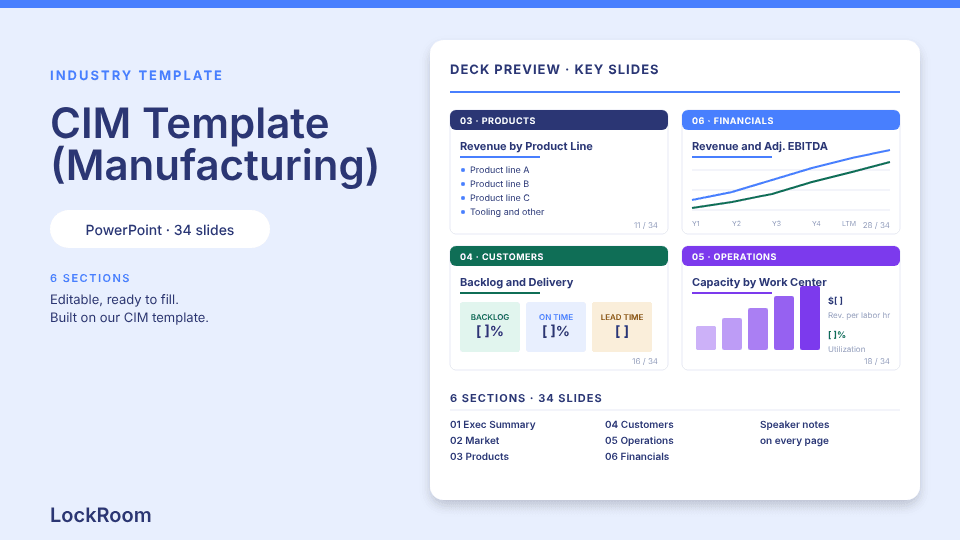
- Revenue by product line with gross margin, active part numbers and customer count, plus end market and customer type mix
- Top ten customers with tenure, share of revenue and contract terms, and revenue grouped by the year each customer first ordered
- Quoting and win rate table, and a bookings, shipments and backlog roll forward with on time delivery and lead times
- Capacity and utilization by work center, a major equipment list with age, debt and replacement value, and tooling ownership
- Quality measures (scrap, rework, returns, first pass yield), a certifications table, suppliers and inventory by stage
- An Adjusted EBITDA reconciliation written for manufacturers, and a working capital schedule built around inventory
- Speaker notes on every content page listing the buyer questions it should answer
Why a manufacturer needs its own CIM
A general CIM template asks for revenue, customers and a management team. A buyer of a manufacturer asks different questions. How much revenue comes from the three largest customers and how long have they been buying? How much firm work is in backlog? What is the bottleneck and how much capacity is open? How old is the equipment and who owns the tooling? How is inventory costed and how much of it is slow moving?
If the CIM does not answer those, the buyer asks them by email, one at a time, and the process slows down. This template gives each answer its own page.
The six sections
- Executive summary. 3 pages. The opportunity, the company history and the investment merits.
- Market. 3 pages. Industry overview, tailwinds and the competitors by capability.
- Products. 4 pages. Products and capabilities, value proposition, revenue by product line, end market and customer mix.
- Customers. 5 pages. Concentration, tenure and retention, quoting and win rate, backlog and delivery, monthly shipments and bookings.
- Operations. 10 pages. Capacity, equipment and tooling, quality and certifications, materials and inventory, workforce, facilities, systems, management, owner transition and the organizational chart.
- Financial overview. 6 pages. Historical summary, profitability by product line, the Adjusted EBITDA reconciliation, revenue growth by product line, working capital and capital expenditures.
A cover, a disclaimer page and a closing page bring it to 34 slides.
What is specific to manufacturing
- Customer concentration with tenure. Every large account shows years as a customer, contract term and whether the company is the sole source.
- Backlog defined. Bookings, shipments and backlog on one table, with book to bill and the share that ships within twelve months.
- Capacity a buyer can model. Hours available and hours run by work center, shifts, and the process that limits output.
- Equipment and tooling. Age, debt or lease balance and replacement value by machine, and whether tooling belongs to the company or the customer.
- Inventory. Costing method, reserve policy, count history, and inventory by stage with turns and aging.
- Maintenance and growth capital spending. Shown separately, because buyers subtract maintenance spending when they value a manufacturer.
How to use it
Everything in yellow is a photo, logo, chart or table to replace or delete. Brackets are blanks. Charts hold round illustrative numbers that you replace with the company's own. The blue italic line at the top of each page is the takeaway: rewrite it as a claim the page proves. Rename the work centers and certification rows to match the plant, and cut any page that does not apply.
Who should use the template
Boutique sell side bankers and M&A advisors taking a manufacturer to market.
Business brokers selling a larger machine shop or fabricator to a strategic or private equity backed buyer.
Owners preparing for a sale who want to see what buyers will ask for.
Pair this with The Teaser Template for the document that goes out before the CIM, The Data Room Folder Structure for where the supporting schedules live, and CIM Template (Full) for the general version.
Other industry versions: CIM Template: HVAC, Plumbing and Electrical, CIM Template: Distribution and CIM Template: Construction and Specialty Contractors.