

CIM Template for HVAC, Plumbing and Electrical Companies
A 34 slide sell side CIM for trades businesses, built on the LockRoom CIM template. It carries the schedules a buyer of an HVAC, plumbing or electrical company asks for in the first week.
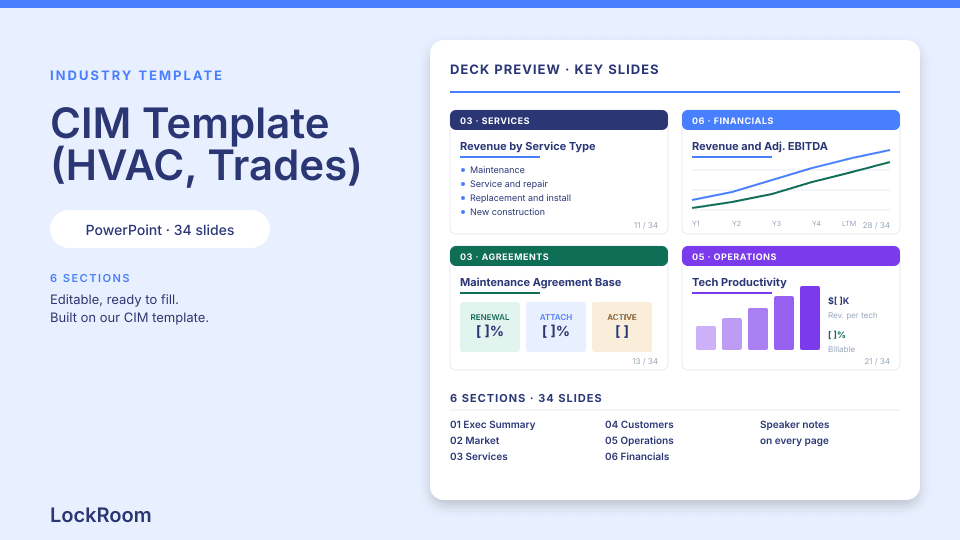
- Revenue by service type (maintenance, service and repair, replacement, new construction) with gross margin, job count and average ticket
- Maintenance agreement roll forward: agreements added and lost, renewal rate, price and deferred revenue
- Technician headcount, tenure and productivity, plus license, bonding and EPA Section 608 schedules
- Lead source performance, job size profile, backlog and customer deposits, seasonality by month
- Fleet schedule, supplier and rebate table, and an owner transition page
- An Adjusted EBITDA reconciliation written for trades, and a working capital schedule with deposits and deferred agreement revenue
- Speaker notes on every content page listing the buyer questions it should answer
Why a trades business needs its own CIM
A general CIM template asks for revenue, customers and a management team. A buyer of an HVAC, plumbing or electrical company asks different questions. How many maintenance agreements are there and how many renew? How much revenue is replacement work and how much is new construction? How many technicians are there, how long have they stayed, and what does each one produce? Who holds the contractor license?
If the CIM does not answer those, the buyer asks them by email, one at a time, and the process slows down. This template gives each answer its own page.
The six sections
- Executive summary. 3 pages. The opportunity, the company history and the investment merits.
- Market. 3 pages. Industry overview, tailwinds and the competitive landscape.
- Company and services. 5 pages. Service lines, value proposition, revenue by service type, residential and commercial mix, the maintenance agreement base.
- Customers and sales. 7 pages. Concentration, cohorts, sales and marketing, lead sources, job size and margin, backlog and deposits, seasonality.
- Operations and people. 7 pages. Technician workforce and productivity, licenses and bonding, suppliers and rebates, systems, management, owner transition, organizational chart.
- Financial overview. 6 pages. Historical summary, branch and trade profitability, the Adjusted EBITDA reconciliation, revenue growth by service type, working capital, fleet and capital expenditures.
A cover, a disclaimer page and a closing page bring it to 34 slides.
What is specific to HVAC, plumbing and electrical
- A four way revenue split. Maintenance, service and repair, replacement, and new construction carry different margins and are valued differently.
- Agreement economics. Count, renewal rate, attach rate, deferred revenue, and visits owed but not yet performed.
- Technicians as capacity. Headcount by role, tenure, turnover, revenue per technician and billable efficiency.
- Licensing. Who the qualifying individual is for each license and whether that person stays after closing.
- Weather and storms. Revenue and jobs by month, and an adjustment line that removes one time storm work.
- Debt like items. Vehicle loans and leases, customer deposits and deferred agreement revenue, laid out so the purchase price bridge holds no surprises.
How to use it
Everything in yellow is a photo, logo, chart or table to replace or delete. Brackets are blanks. Charts hold round illustrative numbers that you replace with the company's own. The blue italic line at the top of each page is the takeaway: rewrite it as a claim the page proves. Cut any page that does not apply.
Who should use the template
Boutique sell side bankers and M&A advisors taking a trades business to market.
Business brokers selling a larger HVAC, plumbing or electrical company to a private equity backed buyer.
Owners preparing for a sale who want to see what buyers will ask for.
Pair this with The Teaser Template for the document that goes out before the CIM, The Data Room Folder Structure for where the supporting schedules live, and CIM Template (Full) for the general version.