

Teaser Template: A Free LMM Sell Side Reference
One page. Tight financial summary. Clean positioning. The lines that get a buyer on the first call. Built with LMM private equity operators who run real sell side processes.
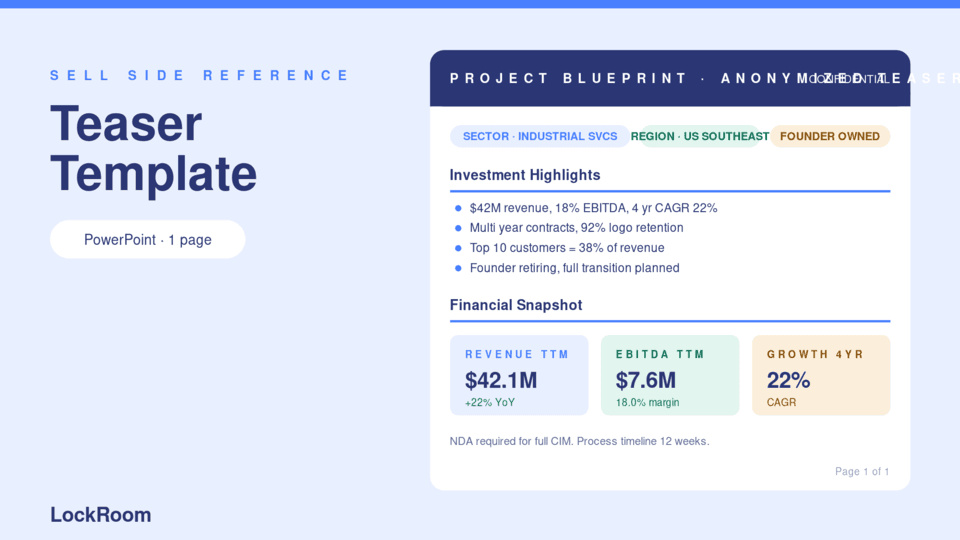
- Anonymized header block (industry, geography, revenue range, ownership) buyers expect
- Five line investment highlights structured around the questions every PE and strategic buyer asks first
- Trailing twelve months and prior year financial summary with the four metrics buyers screen on
- Anonymized customer concentration framing that discloses risk without revealing identity
- Process and contact section with the call to action that converts to NDA
What's in the template
The PowerPoint is a single page split into six blocks:
- Header. Industry, geography, revenue range, ownership type. Anonymized.
- Investment highlights. Five lines structured around the questions buyers screen on first.
- Financials. Revenue, EBITDA, gross margin, and growth rate for trailing twelve months and prior year.
- Customer profile. Anonymized customer concentration and contract characteristics.
- Strategic rationale. Why a buyer should care, framed for both strategics and PE.
- Process and contact. Banker contact, NDA process, indicative timeline.
Why one page
Boutique investment bankers send teasers to 30 to 80 potential buyers per process. Each buyer's deal team reads the first paragraph of every teaser they receive that week. If your teaser is three pages, the bottom two pages are not read.
The one page constraint forces every word to earn its place. Buyers can scan it in 30 seconds and decide whether to sign the NDA. That decision is the only thing the teaser needs to drive.
How buyers screen teasers
The buyer's deal team has four screening questions. Every teaser either answers them or gets passed.
- Is this in our investment thesis? Industry and geography from the header answer this in five seconds.
- Is this in our deal size range? Revenue and EBITDA in the financials section answer this in another five seconds.
- Is this growing? Growth rate. If flat or declining, most PE buyers stop here.
- What's the risk? Customer concentration. Anonymized but disclosed. Hiding it in the teaser surfaces it later as retrade leverage.
The teaser that answers these four questions cleanly converts to NDA at the highest rate. The teaser that buries the answers in marketing language gets discarded.
The five investment highlights that work
Every teaser has an investment highlights section. Most are forgettable. The ones that drive NDAs follow a specific structure:
- Market position. Where the company sits in its market, with one quantified data point.
- Revenue characteristics. Recurring revenue percentage, customer retention, contract length, or whatever metric is the strongest seller in the business.
- Profitability. EBITDA margin and trajectory, with framing for sustainability.
- Growth driver. One specific reason the company should grow, with evidence.
- Strategic angle. Why a buyer (strategic or PE) would specifically want this asset now.
Common mistakes
- Marketing language instead of facts. "Industry leading" is meaningless. "#3 by revenue in [vertical] in [region]" is a fact.
- Skipping customer concentration. Buyers always ask. Disclose it anonymized in the teaser; it builds trust before the buyer discovers it later.
- Generic call to action. The teaser should specify the NDA process and timeline, not invite an open conversation.
- Including identifying details. The teaser is anonymized. Including leadership names, specific customer names, or precise locations defeats the purpose.
Who should use the template
Boutique sell side bankers running multiple LMM processes per year who want a tested teaser structure that converts to NDA at high rates.
Founders running their own sale process without a banker, who need a starting point that signals seriousness to the buyer universe.
Solo M&A advisors looking to standardize teaser quality across deals.
Pair this with The CIM Template Outline for the document the buyer receives after signing the NDA, and The LOI Checklist for what to lock down once a buyer comes back with an offer. Pitching for the mandate itself? Start with The Investor Presentation Template.