

CIM Template Outline: A Free LMM M&A Reference
11 sections with item-level checklists covering executive summary, market, financials, customer concentration, management, and growth thesis. Built from real LMM deals.
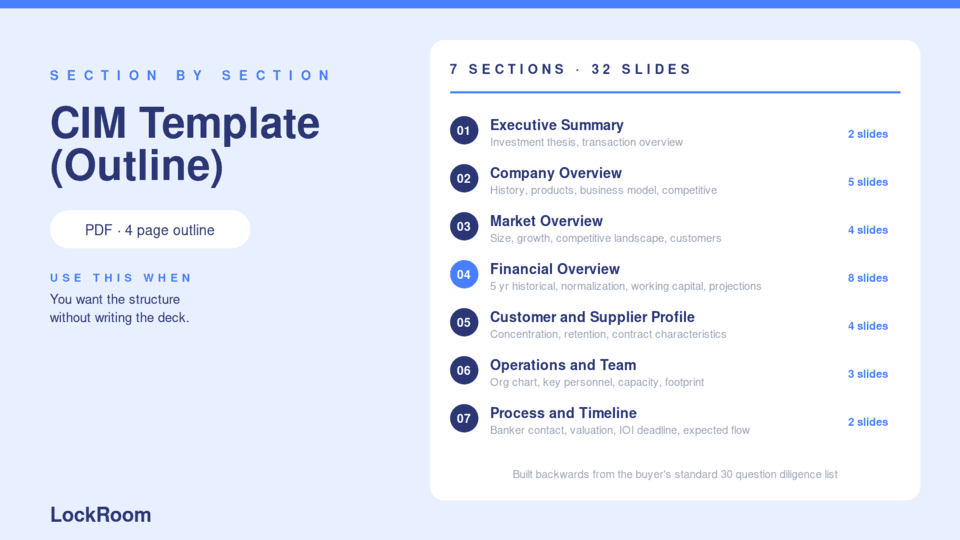
- 11 standard CIM sections with required, recommended, and optional ratings
- Item-level checklist for each section so nothing is forgotten
- Recommended charts and visualizations mapped to each section
- Tone and length guidance, sample structure, common mistakes catalog
What's in the outline
The PDF organizes a CIM into 11 sections with item-level checklists:
- Cover and confidentiality (1-2 pages)
- Executive summary (2-4 pages)
- Company overview (4-8 pages)
- Market opportunity (4-6 pages)
- Business model and operations (4-8 pages)
- Customers (2-4 pages)
- Historical financials (4-8 pages)
- Forecast (2-4 pages)
- Growth strategy (2-4 pages)
- Transaction overview (1-2 pages)
- Appendices (4-10 pages)
Plus:
- Recommended charts mapped to each section
- Tone and length guidance with specific recommendations
- Common mistakes to avoid
Each item has a check box for tracking what's drafted vs pending.
Why this matters
A CIM is the first detailed document bidders read. Quality of the CIM correlates directly with quality of the IOIs received. Bankers who skip sections or rely on marketing language get vague, low-confidence bids.
The outline addresses three CIM failure modes:
1. Hiding concentration or risks. Buyers find these during diligence and lose trust in the seller. Anonymized but transparent disclosure builds trust. See Customer concentration in the CIM.
2. Marketing language without data. "Industry leading" without supporting metrics signals weak fundamentals. Specific numbers signal real understanding.
3. Inadequate financials. Less than 3 years of detail, missing EBITDA bridge, or missing working capital trend look unprepared. The QofE-prepared CIM has all this. See Sell side QofE.
How to use the outline
Step 1: Pull this outline at the start of CIM drafting (week 2-3 of the prep phase).
Step 2: Use the checklist to track progress on each section. Designate a seller-side owner for each section's content.
Step 3: Reference the recommended charts list to ensure visual balance across sections.
Step 4: Apply the tone and length guidance during drafting and review.
Step 5: Run through the common mistakes catalog before final review and distribution.
Who should use the outline
Sell-side bankers structuring CIMs for LMM auctions, especially solo bankers and smaller boutique shops without a standardized internal template.
Founders working with their banker on CIM content, ensuring everything is covered.
Sell-side counsel reviewing CIMs for legal accuracy and consistency with the disclosure schedule.
Buyers receiving CIMs; the outline shows what a professionally-prepared CIM looks like and what's expected.
Ready to draft? The full 28 page CIM template turns this outline into a working document, and The Investor Presentation Template covers the pitch that wins the mandate first.