

Sell-Side Quality of Earnings: When to Run It, What It Costs, What It Catches
Now standard for LMM sellers above $10M EBITDA. $20K-$45K boutique, 4-6 weeks. Pays back many times over by neutralizing retrade leverage before bidders ever see the financials.
- Sell-side QofE is now standard practice for LMM sellers above $10M EBITDA running competitive auctions.
- Cost: $20K to $45K boutique advisory; $50K to $150K Big-4. Boutique tier is recommended for most LMM deals.
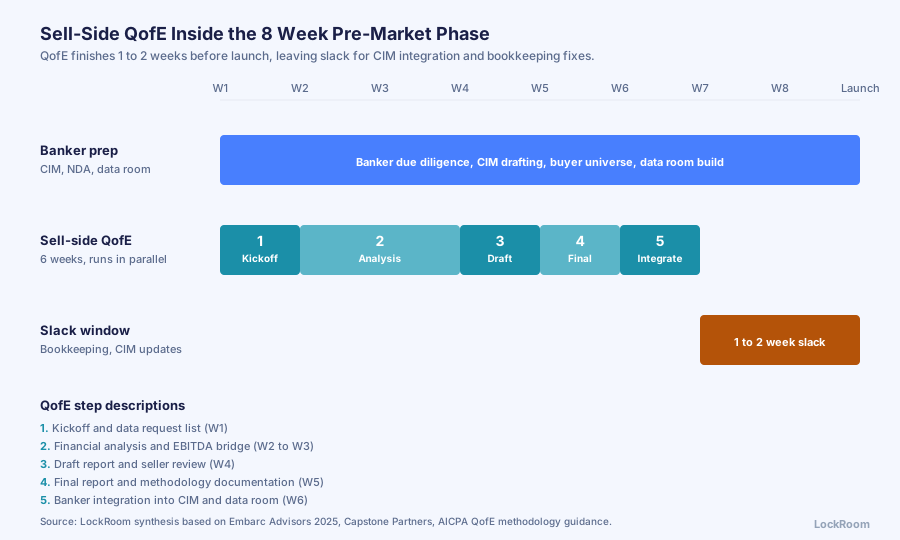
- Timeline: 4 to 6 weeks for boutique engagements, finishing 1 to 2 weeks before going to market.
- Retrade defense math: a typical retrade reduces price 3% to 8% of EV. On a $30M deal that's $900K to $2.4M, paying back the $35K spend many times over.
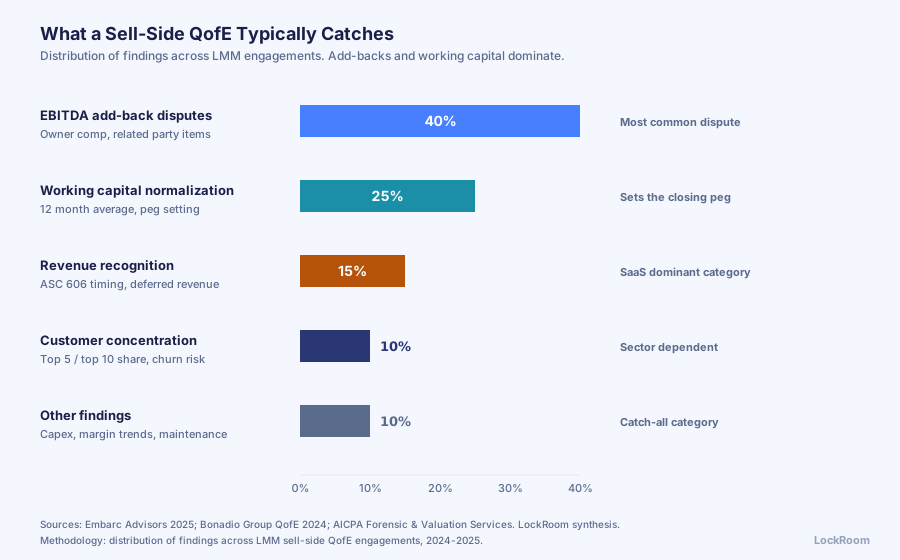
- Most common findings: EBITDA add-back disputes (40% of findings), working capital normalization (25%), revenue recognition (15%), customer concentration (10%).
- Bankers who skip sell-side QofE are leaving cash on the table. Founders who insist on it close faster and at higher prices.
- Pre-LOI is the dominant structure. Post-LOI sell-side QofE is mostly defensive and misses the auction-shaping value.
What is a sell-side quality of earnings?
A sell-side quality of earnings is a third-party financial analysis commissioned by the seller before going to market. An independent accounting firm (typically a transaction advisory boutique, not the seller's audit firm) reviews the trailing twelve to thirty-six months of financials and produces a report with normalized or adjusted EBITDA, working capital trends, revenue quality assessment, and a documented rationale for every add-back.
The report is shared with bidders during diligence. The buyer's QofE provider tests the seller's QofE rather than starting from blank financials. That single change compresses the buyer's diligence timeline and reduces the issues that surface as retrade leverage.
There are two flavors:
Pre-LOI sell-side QofE. Run before the deal goes to market. Bidders see the seller's QofE during the marketing phase. This is the dominant 2026 structure for LMM deals above $10M EBITDA.
Post-LOI sell-side QofE. Less common. Run only after a seller signs an LOI, primarily as a defensive measure against an inbound buyer's QofE findings. Misses the main value (shaping bid valuation), but still useful when an inbound buyer has a reputation for aggressive diligence.
Why are more lower middle market sellers running QofE in 2026?
The product moved down market for four reasons. Each is documented in 2024 and 2025 practitioner commentary.
Buyer QofE became universal. A 2025 Middle Market Growth feature reports that QofE is now standard on essentially all LMM deals above $5M EBITDA. The buyer is going to scrub the financials regardless. The sell-side QofE is a way to scrub them first, on the seller's timeline and methodology, rather than discover problems mid-diligence under the buyer's clock.
Pre-LOI QofE compresses the close timeline. Capstone Partners and other middle market advisors report that deals where the seller had a sell-side QofE close on average 4 to 6 weeks faster than deals without one. The buyer's QofE reviews and tests the seller's report rather than building from raw ledgers, eliminating roughly half the typical 6-week buy-side diligence window.
Retrade prevention pays for itself. A typical LMM retrade negotiation reduces price by 3% to 8% of enterprise value. On a $30M deal, that is $900K to $2.4M of value at risk. A $35K sell-side QofE that catches and addresses the issues before they become buyer leverage often pays back many times over.
Cost dropped to a viable range. Boutique transaction advisory firms now offer focused sell-side QofE engagements in the $20K to $45K range for LMM deals (per Embarc Advisors and Calder's Q2 2025 market update). National accounting firms charge $50K and up. The sub-$50K boutique tier is what made the product economically viable for $10M to $30M EBITDA businesses.
When does a sell-side QofE make sense?
The decision is not yes versus no. It is scope.
Strong fit for a full sell-side QofE:
- $10M+ EBITDA businesses going to a competitive process
- Founders selling who have run lean accounting (no audited financials, owner expenses run through the business, family salaries above market)
- Businesses with significant non-recurring items in the trailing twelve months (one-time customer wins, restructuring, COVID-era distortions)
- Recurring revenue businesses where revenue recognition timing matters (SaaS, subscription services, deferred revenue)
- Sellers who have never been through a QofE and don't know what their financials look like under the buyer's lens
Weaker fit, lighter scope or skip:
- Deals below $5M EBITDA where the absolute spend is too high relative to deal size
- Businesses with audited financials and clean bookkeeping (audit + good controls accomplish much of what QofE does)
- Distressed sales where speed matters more than retrade defense
- Businesses where the seller already has a strong CFO who has been preparing for sale for a year (a "diligence-ready" seller)
Edge cases:
- Asset deals: QofE still useful but scope often narrower (asset financials only)
- Carve-outs: QofE is harder to run pre-LOI because the seller has to allocate parent costs
- International sellers: cross-border QofE adds complexity around accounting policies (US GAAP vs IFRS vs local)
How much does a sell-side QofE cost in 2026?
Cost varies by deal size and provider tier.
Boutique transaction advisory firms (most common LMM tier): $20K to $45K for a focused sell-side QofE on a $5M to $30M EBITDA business. Embarc Advisors, Calder, Bonadio Group, Frazier & Deeter, and similar firms operate in this tier. Engagement scope: trailing 24 to 36 months of financials, EBITDA bridge, working capital analysis, revenue quality, customer concentration analysis.
Big-4 and national accounting firms: $50K to $150K. Deloitte, EY, KPMG, PwC, Grant Thornton, BDO. Used when the seller anticipates an upper middle market buyer who expects a recognized name on the report. Adds brand recognition and sometimes deeper data analytics, but for most LMM processes, the boutique tier produces reports of equivalent quality at a fraction of the cost.
Niche / sector specialists: Varies. Healthcare specialists (e.g., Pinnacle Healthcare Advisory) may charge $40K to $80K because of the regulatory and billing complexity. Software-focused providers (Software Equity Group adjacent firms) similar. Pricing reflects sector-specific diligence depth.
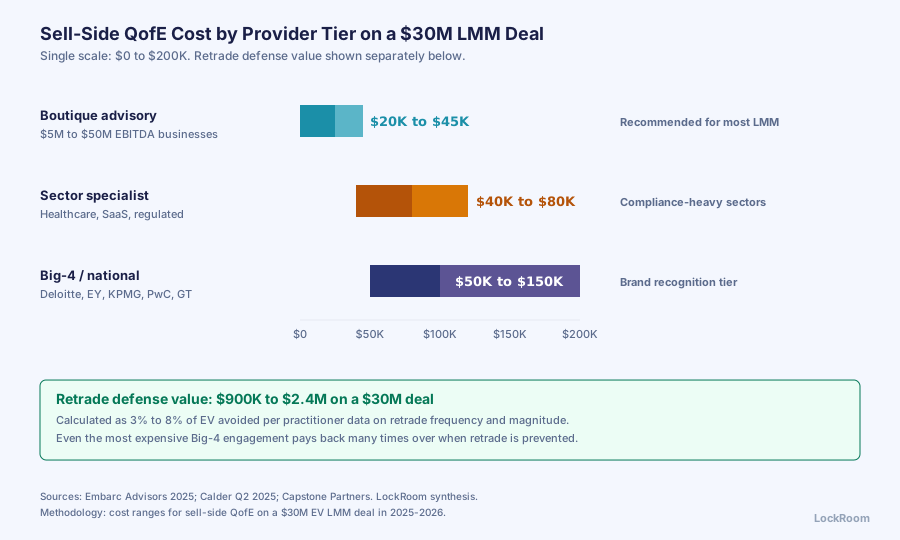
The cost should not be evaluated in isolation. The relevant comparison is the retrade defense value. A $35K spend that prevents a 3% retrade on a $30M deal saves $900K. The math almost always works for $10M+ EBITDA businesses going through competitive processes.
How long does a sell-side QofE take?
Boutique engagements: 4 to 6 weeks from kickoff to final report. Standard breakdown:
- Week 1: Kickoff meeting, document request list, initial data room access
- Weeks 2-3: Financial analysis, EBITDA bridge construction, working capital normalization
- Week 4: Draft report, seller review, Q&A on add-backs
- Week 5: Final report, methodology documentation, executive summary
- Week 6: Banker review, integration into the marketing materials and data room
National firm engagements: 6 to 10 weeks. Larger teams, more sign-offs, typically more documented analytics and deeper sector benchmarking.
The sell-side QofE should be planned to finish 1 to 2 weeks before going to market. That gives the banker time to integrate findings into the CIM, prepare management for likely diligence questions, and make any corrective bookkeeping changes the QofE flagged.
What does a sell-side QofE find?
The same things a buyer's QofE will find. The advantage is finding them first.
EBITDA add-backs that won't survive. This is the most common finding. Owners often add back personal expenses (vehicle, travel, family salary, country club), one-time items (legal settlements, restructuring), and questionable non-recurring items (large bonuses paid out of operations). The QofE distinguishes legitimate add-backs from those a buyer will challenge. AICPA guidance and practitioner commentary identify owner compensation, related-party transactions, non-recurring legal or professional fees, and personal expenses as the four most-disputed categories.
Revenue recognition issues. The QofE checks whether revenue is recognized when earned (per ASC 606) or when invoiced. Common issues: long-term contracts with milestone billing where revenue should be deferred, deposits classified as revenue, channel stuffing in the final months of the trailing twelve, and recognition timing on subscription renewals.
Working capital normalization. The QofE establishes a "normal" working capital level by averaging the trailing twelve months of monthly snapshots. This becomes the working capital peg the buyer will negotiate to. Differences between the seller's reported working capital and the QofE-normalized number show up as price adjustments at close.
Customer concentration. The QofE identifies customer concentration thresholds (often top 5 customers as a percentage of revenue) and flags risks the CIM may have understated.
Run-rate vs trailing-twelve. For high-growth businesses, the trailing twelve understates current run-rate. The QofE often presents both and lets bidders choose how to weight them.
Quality issues that affect EV. Recurring vs non-recurring revenue mix, gross margin trends, customer churn, deferred maintenance capex.
Which EBITDA add-backs survive scrutiny?
Buyers fight every dollar of add-back because each accepted dollar increases the purchase price by the applicable EBITDA multiple. On an 8x deal, $100K of add-back equals $800K of price. The QofE provider's job is to identify which add-backs will hold up.
Add-backs that typically survive:
- Owner compensation above market (replaced with a market-rate hired-CFO equivalent)
- Owner perks and personal expenses run through the business (vehicle, travel, club memberships)
- One-time legal settlements with documented finality
- Non-recurring restructuring charges with documented end date
- Pandemic-era costs (PPE, remote work setup) clearly tied to specific events
Add-backs that frequently get rejected:
- "Synergies" or "growth investments" that the buyer expects to fund post-close
- Marketing or R&D classified as one-time when they are recurring patterns
- Family member salaries above market when the family member is staying post-close
- Stock-based compensation (controversial, often sub-limited or excluded)
- Bonuses to retained employees (usually rejected if employee continues post-close)
The grey zone:
Owner-related expenses that mix personal and business benefit (e.g., a country club membership used for client entertainment). The QofE provider documents the rationale, splits the expense, and produces a defensible position. Buyers often negotiate but rarely fully reject when the documentation is clear.
How does a sell-side QofE prevent retrade?
The retrade math is the most concrete reason to run sell-side QofE. Three mechanisms:
Information asymmetry erodes. Without sell-side QofE, the buyer is the only party with a deep view of the financials post-LOI. The buyer can use findings selectively as retrade leverage. With sell-side QofE, both sides have similar information. The seller has anticipated the issues and can defend against them.
Bidders price-in the QofE during the auction. When the seller's QofE is in the data room during the marketing phase, IOIs and LOIs reflect the QofE-adjusted EBITDA, not the seller's reported EBITDA. The valuation conversation happens upfront, not at the retrade.
The seller's banker has time to remediate. If the QofE flags an issue (e.g., incorrect revenue recognition), the seller has weeks to fix the books before bidders see them. Without sell-side QofE, the same issue surfaces during buyer diligence under tight time pressure.
The data: practitioner reports indicate sell-side QofE reduces retrade frequency by roughly 30% and reduces average retrade magnitude (when retrade does occur) by similar amounts.
Sector-specific notes
Healthcare. Healthcare QofE engagements run higher cost ($40K to $80K boutique tier) due to billing audit requirements, payer mix analysis, and Medicare/Medicaid revenue verification. Healthcare-specific QofE providers (Pinnacle Healthcare Advisory, Stout Healthcare) offer regulatory diligence integrated with financial QofE. See LMM healthcare M&A 2026.
Software / SaaS. SaaS QofE focuses on bookings vs revenue, ARR vs revenue, churn analysis, and gross retention rates. Net Revenue Retention is the metric that drives valuation. SaaS-focused QofE providers do this well; generalist firms sometimes mishandle deferred revenue. See LMM SaaS M&A 2026.
Manufacturing. Working capital is the dominant QofE issue. Inventory aging, customer concentration, and capex normalization. Manufacturing QofE often integrates with operational diligence (capacity utilization, equipment age).
Professional services. Owner compensation is the largest add-back. Customer concentration tied to specific partners or rainmakers is a common red flag. Time-and-materials revenue recognition is straightforward but margin trends matter.
Distribution / wholesale. Working capital and supplier concentration are the focus. Inventory turns, payment terms, vendor consolidation risk.
How do you choose a QofE provider?
Three questions filter providers fast.
Have they done deals at your size? A provider whose typical engagement is $200M+ may not give you the right scope on a $20M deal. A provider whose typical engagement is $5M may not have the capacity or analytics depth you need on a $50M deal.
Have they done deals in your sector? Healthcare, SaaS, manufacturing, and professional services have meaningfully different QofE methodologies. Sector specialization matters above $10M EBITDA.
Is the principal partner doing the work? Boutique firms sell partner-led engagement. National firms often staff partner + senior associate + analysts where the partner reviews the report but doesn't drive the analysis. For LMM deals, principal-led work usually produces better outputs.
Three questions to ask a prospective provider:
- Show me a redacted sample report from a similar deal.
- What percentage of your reports lead to retrade conversations? (A provider whose reports never trigger retrade is missing things; one whose reports always trigger retrade is too aggressive.)
- How many LMM deals have you done in the last 12 months in my sector?
Bottom line
A sell-side quality of earnings is now standard practice for lower middle market sellers running competitive processes above $10M EBITDA. The cost ($20K to $45K boutique) is small relative to the retrade defense value. The timeline (4 to 6 weeks) fits inside the standard pre-market preparation phase. The downside of skipping it is a buyer's QofE that surfaces issues under time pressure with retrade leverage attached.
For sell side bankers running LMM processes:
- Scope the QofE during mandate signing, not after CIM drafting
- Use a boutique tier provider for $10M to $50M EBITDA businesses unless the buyer-set demands a recognized national name
- Time the engagement to finish 1 to 2 weeks before launching the marketing phase
- Integrate findings into the CIM and the data room rather than treating QofE as a parallel artifact
For founders preparing to sell:
- Start the QofE conversation 6 to 9 months before going to market, not 6 weeks
- Use the QofE process as an opportunity to clean up bookkeeping, not just to document what exists
- Treat the QofE provider as part of the deal team, not a vendor
LockRoom data rooms support sell-side QofE workflows directly. Permission tiered access lets you give the QofE provider the financial folder during prep, then share the completed QofE report with bidders during marketing without re-permissioning. Audit logs hold up to buyer-side scrutiny. If you are running a process and want a data room that handles both QofE preparation and bidder access, [start a free trial](/) or [book a demo](/).
QofE Scope Worksheet
The full QofE scope worksheet used by LMM bankers to brief providers and bound engagement cost. Free PDF download.