

Customer Concentration in the CIM: Disclosure, Valuation Impact, and How to Structure Around It
Customer concentration is the #2 source of LMM valuation discount after EBITDA quality. Above 25% from one customer typically reduces valuation 15-30%; above 40% kills deals.
- Customer concentration is the #2 source of LMM valuation discount after EBITDA quality issues. Above 25% from a single customer typically reduces valuation 15% to 30%; above 40% often kills deals outright.
- Diligence thresholds: under 10% per customer is clean and competitive. 10% to 20% triggers attention. 20% to 30% triggers detailed diligence and likely multiple reduction. 30%+ leads many buyers to withdraw.
- SBA lenders financing LMM deals get uncomfortable above 20% per single customer; that constraint forces individual investors and search funds to walk on highly concentrated targets.
- Top 5 customer share is more relevant than top 10 for LMM deals; buyers stress-test the loss of any one of the top 5.
- CIM disclosure approach: anonymize specific customer names but disclose concentration percentages, contract terms, and tenure. Hiding concentration kills trust faster than disclosing it.
- Mitigation tactics: long-term contracts with auto-renewal, multi-year customer commitments, customer diversification ahead of market, structured earnouts that reflect customer retention.
- Bottom line: customer concentration is fixable over 18 to 36 months but rarely in the 6 months before going to market. Founders considering exit should diversify first, then sell.
What is customer concentration?
Customer concentration is the percentage of revenue derived from the top 1, top 5, or top 10 customers. The most common measurement units:
- Single largest customer share: % of revenue from the #1 customer
- Top 5 customer share: % from the top 5 customers combined
- Top 10 customer share: % from the top 10 customers combined
- Customer Herfindahl-Hirschman Index (HHI): sum of squared customer shares, used in some quantitative buyer models
For LMM diligence, the most-watched metrics are single largest customer share and top 5 share. Buyers run scenario analyses on losing the top customer and on losing 1 of the top 5.
What concentration thresholds do buyers use?
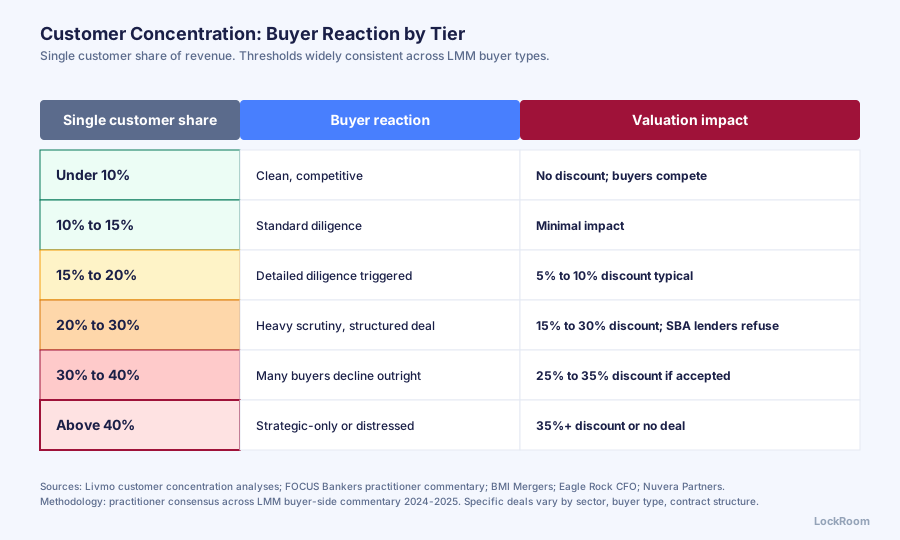
Per practitioner commentary (Livmo, FOCUS Bankers, BMI Mergers), buyer diligence thresholds in 2026:
| Top customer share | Buyer reaction | Valuation impact | |---|---|---| | Under 10% | Competitive, no discount | None (clean) | | 10% to 15% | Standard diligence | Minimal | | 15% to 20% | Detailed diligence | 5% to 10% discount | | 20% to 30% | Heavy scrutiny, structured deal | 15% to 30% discount | | 30% to 40% | Many buyers decline | 25% to 35% discount if accepted | | Above 40% | Strategic-only or distressed pricing | 35%+ discount or no deal |
Buyer-type variation:
- Strategic acquirers: most tolerant of high concentration, especially when the concentrated customer relationship is part of the strategic value
- PE platforms: tolerate up to ~20% with discount; above 25% requires structured terms
- Family offices: similar to PE
- Search funds: more conservative; concentration above 20% is hard to finance through SBA
- Independent sponsors: depend on capital partners' tolerance; varies widely
- SBA-financed individual investors: SBA lenders get uncomfortable above 20%, typically refuse above 25%
Why does concentration trigger such large discounts?
Three reasons drive the math.
Loss of the customer eliminates the EBITDA being valued. If the top customer is 30% of revenue and 50% of EBITDA (concentrated customers often carry above-average margin), losing them reduces purchase price-affecting EBITDA by 50%. The buyer is paying for revenue and earnings that may evaporate.
Renewal risk is asymmetric. A customer producing 30% of revenue may be on a 1-year contract that auto-renews, on a 3-year contract with a renewal option, on a master services agreement with no specific term, or on a handshake. Without long-term contractual lock-in, the buyer assumes higher renewal risk than the seller does.
Negotiating leverage shifts post-close. A customer aware of the acquisition may negotiate price reductions or extended terms knowing the new owner is desperate to retain them. This is especially common when the customer is significantly larger than the acquired business.
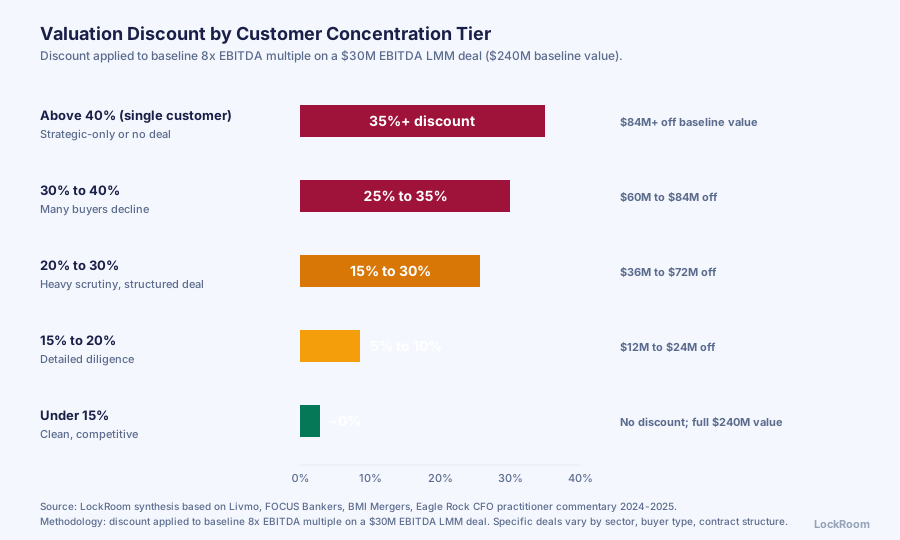
The valuation math:
``` Pre-discount value: $30M EBITDA × 8x multiple = $240M Concentration risk adj: 25% discount = -$60M Post-discount value: $180M ```
This is a stylized example. In actual diligence, the buyer runs a scenario analysis (lose the top customer, retain 80% of historic margin, requires X new customers to replace) and the discount is the present value of the gap. But the principle is the same: concentration discounts are not arbitrary; they reflect the buyer's expected loss in a worst-case scenario.
How do you disclose customer concentration in the CIM?
The dominant practitioner consensus: disclose accurately, anonymize names, frame contractually.
Disclose accurately. Show the top 10 customer share as a percentage of trailing 12-month revenue. Don't hide concentration; experienced buyers will find it during diligence and lose trust if it was obscured.
Anonymize names. Customer 1, Customer 2, etc. Real names appear in the data room during exclusivity, not in the CIM. Anonymization protects the seller from competitors who learn the customer list.
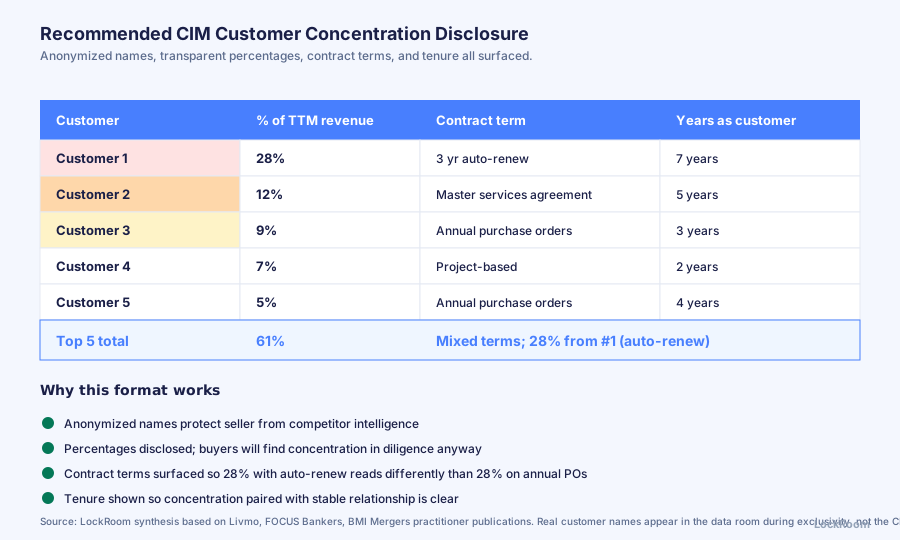
Frame contractually. Show contract terms and tenure alongside the concentration percentages:
| Customer | % of revenue | Contract term | Years as customer | |---|---|---|---| | Customer 1 | 28% | 3 yr auto-renew | 7 years | | Customer 2 | 12% | Master services agreement | 5 years | | Customer 3 | 9% | Annual purchase orders | 3 years | | Customer 4 | 7% | Project-based | 2 years | | Customer 5 | 5% | Annual purchase orders | 4 years | | Top 5 total | 61% | | |
A 28% top customer with a 3-year auto-renewing contract and 7-year tenure is a substantively different proposition from a 28% top customer on annual purchase orders with 18-month tenure. The CIM should make this distinction visible.
Don't soften with phrases. Avoid "diversified base" or "long-standing relationships" if the numbers don't support it. Buyers see through phrasing and lose trust.
What can sellers do to reduce concentration risk before going to market?
Customer concentration is fixable over 18 to 36 months but rarely in the 6 months before launch. Tactical playbook:
1. Long-term contracts with auto-renewal. Convert annual purchase orders or handshake relationships into 3 to 5 year contracts with auto-renewal clauses. Customers comfortable with the relationship will sign; the contract becomes a buyer reassurance during diligence.
2. Multi-year commitments with volume floors. Customers who agree to minimum annual purchase commitments give the buyer downside protection.
3. Diversify customer base ahead of exit. 18 to 24 months ahead of a planned exit, focused sales on additional customers reduces single-customer concentration. The math works: adding $5M of revenue across 5 customers spread over 24 months can move the top customer from 30% to 22%.
4. Capture customer references in writing. Reference letters from top customers documenting satisfaction and intent to continue create soft commitments that smooth diligence.
5. Document customer relationship details. Buyers want to know: who is the executive sponsor at the customer, who handles day-to-day, what is the renewal process, what are the alternative providers. Documentation the seller maintains becomes data room content during diligence.
6. Renegotiate contracts with concentration trigger language. Some contracts have clauses giving the customer the right to renegotiate or terminate on a change of control. Renegotiating those clauses (or replacing them with consents that the customer pre-grants) protects the deal value.
If concentration mitigation isn't possible before launch, the alternative is to price the discount into the valuation conversation upfront and use deal structure (earnouts, contingent consideration tied to customer retention) to bridge the gap.
When does concentration kill a deal entirely?
Per practitioner commentary, deals tend to fall apart when:
- Single customer above 40% with no long-term contract
- Top 3 customers above 70% with weak contractual lock-in
- Single customer above 30% AND that customer has indicated it may renegotiate or terminate post-close
- The customer is significantly larger than the acquired business and has pricing leverage
- The customer is in an industry consolidating (the customer may itself be acquired and switch suppliers)
In these cases, the concentration discount becomes 35%+ and structured deal terms (earnouts, holdbacks, customer retention contingencies) become the only feasible path.
What about contract dependencies (not just customer concentration)?
A related risk is contract dependency: a single contract that produces a large share of revenue, even if the customer relationship spans multiple contracts. A 3-year master agreement that contains a renewal option giving the customer the right to renegotiate creates dependency risk even if the customer relationship is otherwise solid.
Buyers diligence both customer concentration and contract dependency. The two are not the same: a customer with five separate contracts has lower dependency than a customer with one contract, even if the total revenue is the same.
Sector-specific concentration patterns
Healthcare services. Payer concentration (Medicare, Medicaid, top 3 commercial payers) often dominates customer concentration. Concentration above 60% from government payers is common and not necessarily disqualifying given payer stability.
Software / SaaS. Customer concentration is the primary valuation discount lever. Net revenue retention (NRR) and gross retention are the key metrics; concentrated SaaS businesses with strong retention often value better than diversified SaaS with weak retention.
Manufacturing. Customer concentration plus volume commitment is critical. A 40% top customer with a 5-year volume commitment is treated very differently than a 40% top customer on annual orders.
Industrial services. Route density and contract structure interact with customer concentration. Concentrated route-based services with long contracts often value at standard multiples.
Professional services. Customer concentration ties to specific partners or rainmakers. The risk is partner departure as much as customer departure.
Distribution / wholesale. Customer concentration plus supplier concentration creates compounded risk. Buyers focus on both sides.
Bottom line
Customer concentration is among the top valuation discount factors in LMM M&A. Above 25% from a single customer typically reduces deal value 15% to 30%; above 40% often kills deals outright. Disclosure in the CIM should be transparent, with concentration percentages, contract terms, and tenure all surfaced.
For sell-side bankers running LMM processes:
- Surface concentration data early in the marketing materials, not late in diligence
- Frame customer relationships contractually (term, tenure, auto-renewal)
- Anticipate the discount in initial price expectations; don't promise pre-discount value
- Use deal structure (earnouts tied to retention) to bridge gaps when valuation expectations diverge
For founders considering exit:
- Address concentration 18 to 36 months before launch if possible
- Convert annual purchase orders to multi-year contracts
- Diversify customer base ahead of going to market
- Recognize that 30%+ from a single customer significantly limits buyer pool
For buyers:
- Diligence concentration deeply: contract terms, customer health, renewal risk, alternative providers
- Run scenario analysis on losing the top 1 and top 3 customers
- Negotiate change-of-control clauses with the seller's customers before close where possible
- Price concentration realistically; do not overpay for revenue that depends on a single counterparty
LockRoom data rooms support customer concentration diligence directly. The folder structure includes a dedicated Customer & Contracts section so buyers can pull contract terms, tenure data, and renewal documents alongside revenue concentration analysis. Permission tiers let bidders see anonymized concentration data in early diligence and named customer documents only after deeper engagement. If you are running a process with concentration considerations and want a data room organized for this diligence, [start a free trial](/) or [book a demo](/).
CIM Template Outline
The full LMM CIM outline LockRoom uses with sell side bankers. Section by section structure including the customer concentration disclosure pattern. Free PDF download.