

CIM Template (Full): A Free LMM Sell Side Reference
28 pages built with LMM private equity operators. Tells the story, defends the valuation, answers the questions buyers ask before they get asked. The template that mirrors what real LMM sell side bankers send.
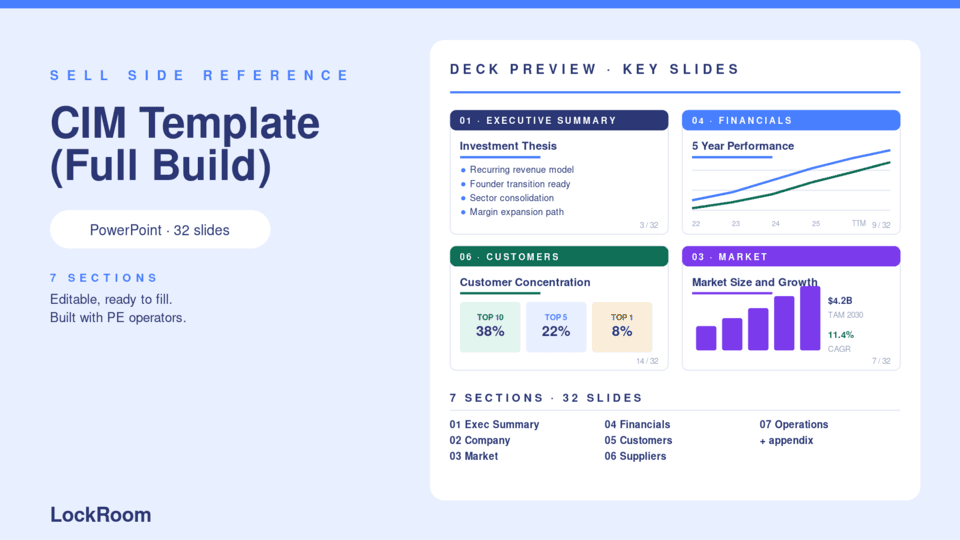
- Executive summary and investment thesis structured for both strategic and PE buyers
- Company overview with the historical, market position, and competitive sections buyers expect
- Five years of financial detail with normalization, working capital trend, and projection methodology
- Customer, supplier, and operational sections that disclose concentration and risk before diligence finds them
- Process section with timeline, contacts, and indicative valuation framework
- Speaker notes throughout pointing out the buyer questions each slide pre answers
What a CIM does
A good CIM does three things: tells the story, defends the valuation, answers the questions buyers ask anyway.
A bad CIM creates more questions than it answers and adds weeks to the timeline. Every unanswered question becomes a follow up email. Every follow up gives the buyer another shot at retrade.
The full template is 28 pages, organized into seven sections. Each section is structured around the questions buyers actually ask.
The seven sections
- Executive summary and investment thesis. 2 pages. The version of the company the seller wants the buyer to remember.
- Company overview. 5 pages. History, products and services, business model, competitive position.
- Market overview. 4 pages. Market size, growth, competitive landscape, customer dynamics.
- Financial overview. 8 pages. Historical financials, normalization, working capital, projections with methodology.
- Customer and supplier profile. 4 pages. Concentration, retention, contract characteristics, key relationships.
- Operations and team. 3 pages. Org chart, key personnel (anonymized), operating capacity, geographic footprint.
- Process and timeline. 2 pages. Banker contact, indicative valuation, IOI deadline, expected process flow.
Why this template
Most CIMs we see have one of two problems. Either they are 50+ pages of marketing language that buyers do not read, or they are 12 page sketches that serious buyers do not take seriously. The 28 page template is the LMM sweet spot: enough to be credible, short enough to be read.
The structure is built backwards from the buyer's standard diligence question list. Each section pre answers questions before they are asked. The buyer reads the CIM, has fewer questions, signs the LOI faster, and the seller compresses the process timeline.
The 30 questions every CIM should pre answer
The template includes speaker notes per slide pointing out which buyer questions that slide neutralizes. The full list:
- What does the company do? Who buys it? Why does it work?
- How big is the market? What is the growth rate? Who are the competitors?
- What are the historical financials and what is the trajectory?
- What are the EBITDA add backs? Are they defensible?
- What is the customer concentration? Top 5, top 10, top 20?
- What is customer retention? Cohort by cohort?
- What are contract terms and lengths?
- What is the supplier concentration?
- How does the team scale? Who is critical to retention post close?
- What is working capital seasonality and trajectory?
- What is the capex requirement going forward?
- What is the projection methodology and the sensitivity?
- What deals comparable to this one have closed recently and at what multiples?
- What are the risks? Customer concentration, supplier risk, key person, regulatory?
- What is the seller looking for in a buyer? Strategic, PE, family office?
The CIM that pre answers these gets to LOI faster. The CIM that does not gets a 200 question diligence list in week 2.
Who should use the template
Boutique sell side bankers running LMM processes who want a tested CIM structure that converts to LOI at higher rates than ad hoc CIMs.
Founders running a process without a banker, who need a starting point that signals seriousness to the buyer universe.
Sell side associates and analysts drafting CIMs under partner review.
Pair this with The Teaser Template for the document that goes out before the CIM, and The LOI Checklist for what to lock down when buyers come back with offers.