

Data Room Folder Structure: A Free LMM Sell Side Reference
12 top level folders. 80+ sub folders. Maps directly to the standard buyer diligence request list. The structure boutique sell side bankers use on real LMM processes.
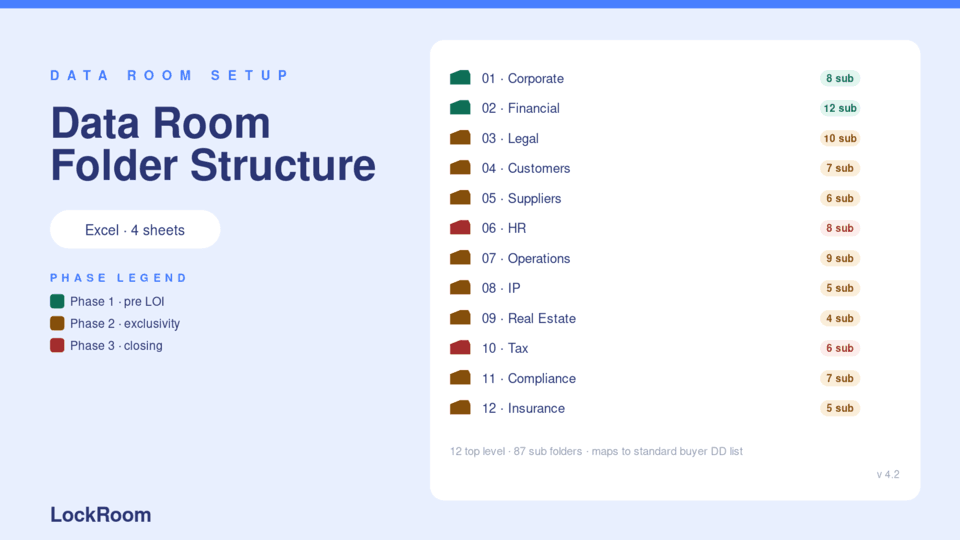
- 12 top level folders matching standard buyer diligence categories: Corporate, Financial, Legal, HR, Operations, IP, Customers, Suppliers, Real Estate, Tax, Compliance, Insurance
- Sub folder breakdown for each top level (4 to 8 sub folders per top level)
- Sector specific variations (SaaS, manufacturing, healthcare services, professional services, building products)
- Permission tier mapping (Phase 1 pre LOI, Phase 2 exclusivity, Phase 3 closing) for every folder
- Mapping to standard Bloomberg Law / ABA diligence request list line items
- One click import compatibility with LockRoom data rooms
Why folder structure matters
The buyer's diligence team logs into a data room for the first time and decides within 90 seconds whether the seller is organized or chaotic. That decision shapes every subsequent request, every retrade attempt, every closing condition.
A clean folder structure is leverage. A messy one is liability.
The buyer who can find the customer concentration analysis in 10 seconds asks the next question. The buyer who has to email the banker to find it loses faith in the seller's readiness, which surfaces as additional scrutiny on every other section.
The 12 top level folders
- Corporate. Articles, bylaws, cap table, board minutes, equity holders, prior M&A activity, subsidiary org charts.
- Financial. Audited financials, monthly management reports, AR aging, AP aging, working capital trends, capex split, revenue by customer, gross margin analysis, sell side QofE if produced.
- Legal. Material contracts (top 20 each on customer and supplier side), leases, loan agreements, equipment financing, litigation, regulatory correspondence.
- Customers. Top 20 by revenue, concentration analysis, retention by cohort, customer contracts, profitability, recent wins and losses.
- Suppliers. Top 20 by spend, concentration analysis, single source dependencies, supplier credit terms.
- HR. Org chart, headcount by function, compensation structure (anonymized initially), benefits programs, employee handbook, stock option grants, non compete agreements.
- Operations. Sector specific: production capacity (manufacturing), engineering team and tech stack (SaaS), route density and contract length (industrial services).
- IP. Patents, trademarks, copyrights, trade secret protocols, open source software usage, IT systems documentation.
- Real Estate. Owned property deeds, lease agreements, environmental assessments, property tax history.
- Tax. Federal returns, state returns, sales tax filings, property tax records, tax election history, NOL documentation.
- Compliance. Sector specific: HIPAA (healthcare), Reg S-P (financial services), ITAR (government contractors), FDA/USDA (food and beverage).
- Insurance. D&O, general liability, cyber, E&O, claims history, recent renewal correspondence.
Permission tiers
Three tier model:
- Phase 1 (pre LOI, anyone with NDA): Anonymized financials, anonymized customer concentration, market overview, public legal entity info.
- Phase 2 (post LOI, exclusive buyer): Full historical financials with names, identified customer contracts, full HR data structure (anonymized salaries), tax returns, all folders except sensitive employee comp.
- Phase 3 (closing diligence): Sensitive employee compensation, sensitive customer contract terms, related party transactions, litigation strategy documentation.
Bankers who blur Phase 2 and Phase 3 access waste leverage. Sensitive material should require explicit progression.
Sector specific variations
The template includes adjusted sub folder structures for the most common sectors:
- SaaS. Heavy IP (open source compliance, security), heavy Operations (engineering, uptime metrics).
- Manufacturing. Heavy Operations (capacity, environmental), heavy Real Estate, working capital sub folders in Financial.
- Healthcare services. Heavy Compliance (HIPAA, payer mix), heavy HR (physician contracts, compensation), MSO structure documentation in Corporate.
- Insurance services. Heavy Customers (book of business, retention), heavy Compliance (state licensing).
- Building products. Heavy Operations (route density, equipment), heavy Customers (recurring contracts, retention).
- Professional services. Heavy HR (partner compensation, retention), heavy Customers (concentration, partner attribution).
- Industrial services. Heavy Operations (route data, contract length), heavy Real Estate (facilities), heavy Compliance (environmental).
- Consumer. Heavy Operations (supply chain), heavy IP (brand, trademarks), heavy Compliance (FDA/USDA).
Who should use the template
Boutique sell side bankers setting up data rooms for LMM processes who want a structure that maps to standard buyer diligence requests.
Sell side counsel reviewing data room organization for diligence readiness.
Founders running a self managed sale process who need to know what buyers will ask for.
Pair this with The Sell Side Diligence Prep Checklist for the documents that go inside each folder, and The LOI Checklist for what to lock down once buyers come back with offers.
For the reasoning behind the taxonomy, naming conventions, and the index PDF that saves buyer side hours, read the sell side data room folder structure guide.