

Sell-Side Diligence Prep Checklist: A Free LMM M&A Tool
Mapped to the six buyer workstreams (financial, legal, commercial, operational, IT/cyber, environmental) modern LMM buyers run during exclusivity. Pre-launch ready.
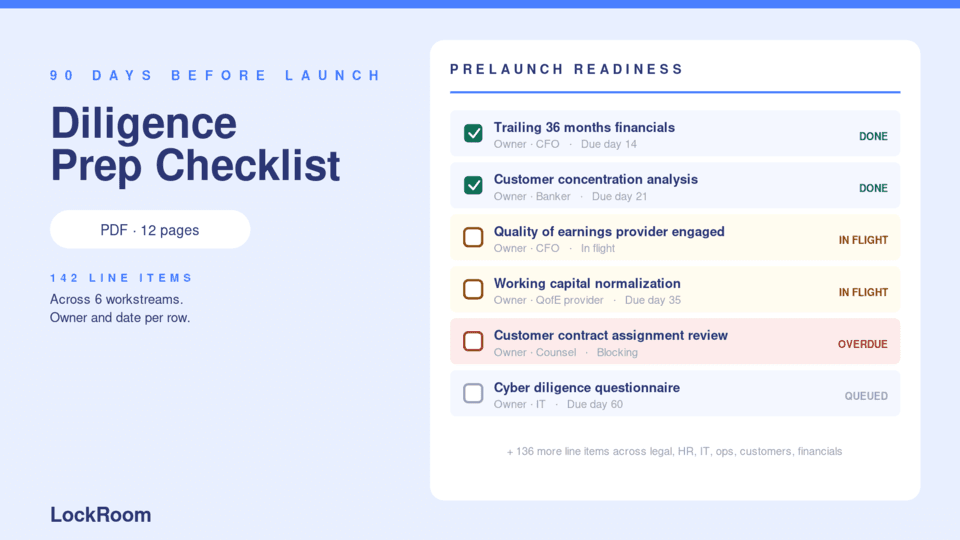
- 6 workstreams scored before launch: financials, customers, contracts, legal, HR, IT
- Item-level data room prep tasks with owners and deadlines
- Buyer-side timing expectations per workstream
- Pre-launch readiness scorecard you can hand to the deal team
What's in the checklist
The PDF organizes diligence prep into the six workstreams modern LMM buyers run during exclusivity:
1. Financial diligence (52 items): historical financials, working capital and balance sheet, revenue and customer detail, EBITDA and add-backs, tax.
2. Legal diligence (36 items): corporate records, material contracts, litigation and compliance, intellectual property, employment.
3. Commercial diligence (15 items): market and customers, sales pipeline and revenue trajectory, growth strategy.
4. Operational diligence (15 items): organization and team, operations and process, supply chain and vendors.
5. IT and cyber diligence (20 items): technology stack, cybersecurity, data and privacy, AI usage (new for 2026).
6. Environmental and regulatory diligence (15 items): environmental, regulatory licenses, sector-specific items.
Each item has a check box for tracking completion. Sector-specific items are called out separately for healthcare, software/SaaS, manufacturing, financial services, and insurance services.
How to use the checklist
Step 1: Download the PDF and either work through it digitally or print for working sessions with the seller's CFO, GC, and operations team.
Step 2: Map each checklist item to a folder in your data room. The structure should mirror the buyer's workstream organization. See Sell side data room folder structure for the recommended folder hierarchy.
Step 3: Designate a seller-side owner for each major workstream:
- Financial: CFO
- Legal: General Counsel or outside counsel
- Commercial: Sales / Marketing leader
- Operational: COO
- IT and cyber: CTO or IT Director
- Environmental/regulatory: GC plus sector-specific lead
Step 4: Track completion percentage weekly during pre-launch prep. The banker's role is operational coordination across these owners.
Step 5: Pre-load standard items at the marketing phase, not under diligence pressure. Items added late in diligence look like late discoveries even when they're not. See Post-LOI retrade defense.
Step 6: Review each section with the seller before going to market. Items the seller can't readily produce signal preparation gaps that need to be addressed.
Why this matters
Per practitioner data, well-organized data rooms compress buyer diligence by 1-2 weeks compared to poorly organized ones. On a 60-90 day exclusivity, that's 15-25% timeline improvement.
More importantly, items pre-loaded in the data room don't appear as "discoveries" during buyer diligence. The seller's banker controls the narrative. Items that surface late in diligence look like discoveries to the buyer's QofE provider, environmental consultant, or legal team — and discoveries drive retrade conversations.
The checklist reduces retrade vectors by:
- Eliminating "missing information" findings (the most common retrade trigger)
- Forcing the seller to confront issues pre-launch rather than mid-diligence
- Documenting completeness, which protects against post-close indemnity claims
- Demonstrating professional preparation to bidders, which signals real seller alternatives
Who should use the checklist
Sell-side bankers running LMM auctions who want to compress diligence and reduce retrade exposure.
Founders preparing for sale who want to understand the scope of what buyers will request.
Sell-side counsel drafting purchase agreements and disclosure schedules from organized source documents.
Buyers building their own diligence checklists; the template shows what's reasonable to expect from a professionally-managed seller.
Data room administrators structuring the room before launch.