

CIM Template for Construction and Specialty Contractors
A 34 slide sell side CIM for project based contractors, built on the LockRoom CIM template. It carries the schedules a buyer of a construction company asks for in the first week: backlog, work in progress, bonding and estimate accuracy.
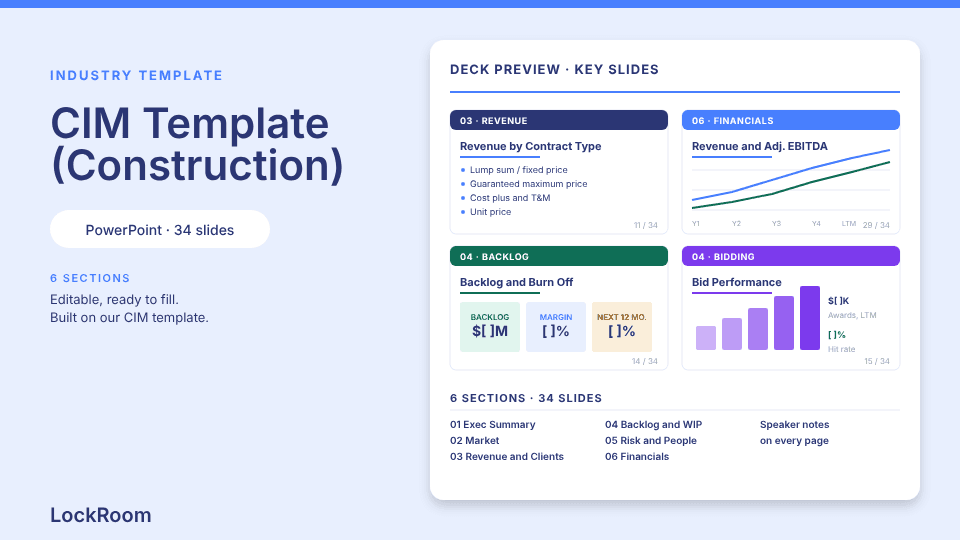
- Revenue by project type and end market, by contract type (lump sum, guaranteed maximum price, cost plus, time and materials, unit price) and by role (prime or subcontractor)
- Backlog roll forward and burn off schedule, with awarded work shown apart from contracted backlog
- Work in progress schedule: contract value, estimated cost, cost to date, percent complete, billed to date, over and under billings, retainage
- Estimate accuracy and profit fade: margin at bid, at the halfway point and at completion for completed jobs, plus loss jobs
- Bonding and insurance, safety record (EMR, TRIR, DART), licenses and prequalifications, change orders, claims and retainage
- Project team and field labor, subcontractors and suppliers, equipment fleet, and an owner transition page
- An Adjusted EBITDA reconciliation and a working capital schedule laid out for a contractor
- Speaker notes on every content page listing the buyer questions it should answer
Why a contractor needs its own CIM
A general CIM template asks for revenue, customers and a management team. A buyer of a construction company starts somewhere else. How much work is under contract and at what margin? Do jobs finish at the margin they were bid? Which open jobs are overbilled or underbilled? Can the company still get bonds once the owner's personal guarantee is gone?
If the CIM does not answer those, the buyer's accountants ask them one at a time and the process slows down. This template gives each answer its own page.
The six sections
- Executive summary and company. 4 pages. The opportunity, the company history, the investment merits and the scopes of work, led by backlog.
- Market. 3 pages. The local market, what drives it, and who the company bids against.
- Revenue and clients. 4 pages. Project type and end market, contract type and role, client concentration, a representative project.
- Backlog and work in progress. 5 pages. Backlog and burn off, pipeline and bid performance, the work in progress schedule, estimate accuracy and profit fade, job size and margin.
- Risk and people. 9 pages. Change orders, claims and retainage, bonding and insurance, safety, licensing and prequalification, project team and field labor, subcontractors and suppliers, systems, management, owner transition, organizational chart.
- Financial overview. 6 pages. Seasonality, historical summary, the Adjusted EBITDA reconciliation, growth by project type, working capital, equipment and capital expenditures.
A cover, a disclaimer page and a closing page bring it to 34 slides.
What is specific to construction
- Backlog first. Contracted backlog, its margin and when it burns off appear on the first content page and get a full page of their own.
- The work in progress schedule. The page a buyer's accountants rebuild first, with over and under billings and retainage beside each job.
- Profit fade. Margin at bid against margin at completion, job by job, so a buyer can judge the estimating.
- Bonding. Single and aggregate limits, how much is in use, who indemnifies the surety today and what changes in a sale.
- Safety and prequalification. EMR and incident rates over three years, and the licenses and certifications that depend on a person or on the current owner.
- Debt like items. Overbillings, retainage, equipment loans and related party equipment, laid out so the purchase price bridge holds no surprises.
How to use it
Everything in yellow is a photo, logo, chart or table to replace or delete. Brackets are blanks. Charts hold round illustrative numbers that you replace with the company's own. The blue italic line at the top of each page is the takeaway: rewrite it as a claim the page proves. Cut any page that does not apply, such as bonding for a contractor that does no bonded work.
Who should use the template
Boutique sell side bankers and M&A advisors taking a contractor to market.
Business brokers selling a larger construction or specialty contracting business to a strategic or private equity backed buyer.
Owners preparing for a sale who want to see what buyers will ask for.
Pair this with The Teaser Template for the document that goes out before the CIM, The Data Room Folder Structure for where the supporting schedules live, and CIM Template (Full) for the general version.
Other industry versions: CIM Template: HVAC, Plumbing and Electrical, CIM Template: Manufacturing and CIM Template: Distribution.