

CIM Template for Distribution Companies
A 34 slide sell side CIM for wholesale and industrial distributors, built on the LockRoom CIM template. It carries the schedules a buyer of a distributor asks for in the first week.
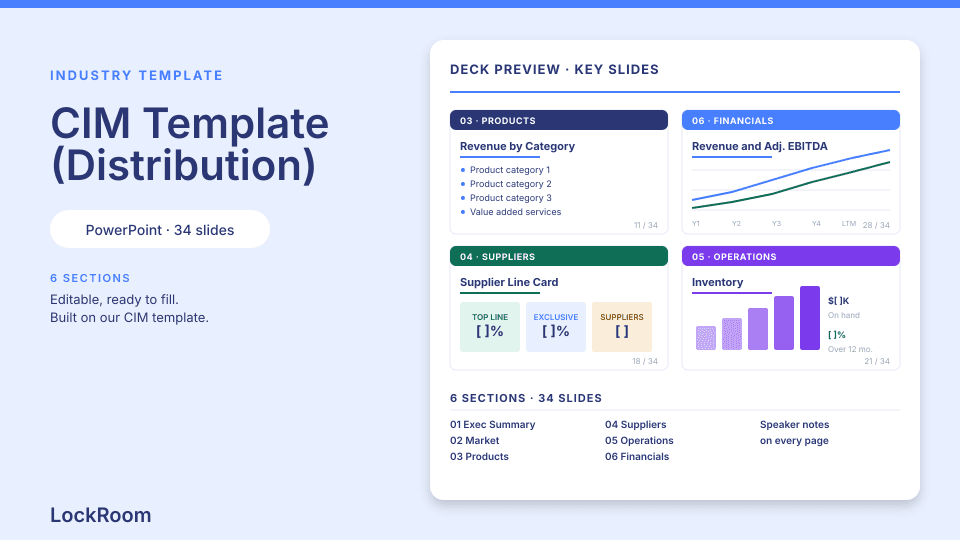
- Revenue and gross margin by product category, customer segment, branch and salesperson
- A price, volume and mix bridge, revenue by pricing type, and how supplier cost increases are passed through
- Supplier line card: concentration, years carried, lines added and lost, and a table of agreements with territory rights and change of control terms
- Supplier rebate programs and a rebates by period schedule that reconciles earned to received
- Inventory by category with turns, aging and reserve, plus fill rate, same day shipment and count accuracy
- An Adjusted EBITDA reconciliation written for distributors, and working capital with the cash conversion cycle and a monthly view
- Speaker notes on every content page listing the buyer questions it should answer
Why a distributor needs its own CIM
A general CIM template asks for revenue, customers and a management team. A buyer of a distributor asks different questions. Is growth real volume or supplier price increases passed through? Will the supplier lines survive a change of owner? How much of gross profit is rebate income, and was it booked in the right year? Is the inventory saleable? Who holds the customer relationships?
If the CIM does not answer those, the buyer asks them by email, one at a time, and the process slows down. This template gives each answer its own page.
The six sections
- Executive summary. 3 pages. The opportunity, the company history and the investment merits.
- Market. 3 pages. Industry overview, tailwinds and the competitive landscape.
- Products and customers. 9 pages. Products and services, value proposition, revenue and margin by category, segment and fulfillment mix, price, volume and mix, customer concentration, cohorts, sales and marketing, sales force and account ownership.
- Suppliers and inventory. 4 pages. Line card and concentration, agreements and territory rights, rebates, inventory.
- Operations and people. 6 pages. Warehouses and delivery, systems, seasonality and monthly working capital, management, owner transition, organizational chart.
- Financial overview. 6 pages. Historical summary, branch profitability, the Adjusted EBITDA reconciliation, growth by product category, working capital, equipment and capital expenditures.
A cover, a disclaimer page and a closing page bring it to 34 slides.
What is specific to distribution
- Price, volume and mix. A bridge that separates supplier price inflation from real volume, with pricing type and pass through timing beside it.
- Supplier lines. Which lines are written down, exclusive or protected, what each agreement says about a sale, and who holds the relationship.
- Rebates. Every program, how it is accrued, and a schedule that ties rebates earned to cash received and to inventory.
- Inventory. Aging by category, the reserve method, write offs and count accuracy, laid out the way a diligence team will rebuild them.
- Account ownership. Revenue and gross profit by salesperson, with tenure and whether each has signed an agreement.
- Working capital. Days outstanding, the cash conversion cycle and a month by month view, since the working capital target is negotiated from these.
How to use it
Everything in yellow is a photo, logo, chart or table to replace or delete. Brackets are blanks. Charts hold round illustrative numbers that you replace with the company's own. The blue italic line at the top of each page is the takeaway: rewrite it as a claim the page proves. Rename the product categories and customer segments to fit the company. Cut any page that does not apply, such as branch profitability for a single site business.
Who should use the template
Boutique sell side bankers and M&A advisors taking a distributor to market.
Business brokers selling a larger distribution business to a strategic or private equity backed buyer.
Owners preparing for a sale who want to see what buyers will ask for.
Pair this with The Teaser Template for the document that goes out before the CIM, The Data Room Folder Structure for where the supporting schedules live, and CIM Template (Full) for the general version.
Other industry versions: CIM Template: HVAC, Plumbing and Electrical, CIM Template: Manufacturing and CIM Template: Construction and Specialty Contractors.