

Working capital and net debt in LMM M&A
Pegs, disputes, and closing adjustments. The mechanism is on 90% of deals and drives the most common post-close retrade lever. Define methodology in the LOI, not the purchase agreement.
- Working capital adjustments now appear on over 90% of private M&A deals, up from roughly 50% a decade ago (SRS Acquiom 2025 Working Capital PPA Study, 1,200 deals).
- The buyer's initial purchase price adjustment claim averages 0.9% of transaction value; 24% of claims exceed 1% of EV.
- Median PPA escrow has grown to ~1% of transaction value in 2024-2025.
- Sellers accept the buyer's PPA calculation in 70% of cases; median dispute resolution time is two months.
- The true up window is typically 60 to 90 days post-close.
- Working capital disputes are the #1 source of post-close conflictin LMM deals.
- Bottom line: define the methodology in the LOI, not the purchase agreement. Items decided post-LOI almost always favor the buyer.
Working capital is the closing adjustment that surprises every seller. The deal closes at $30M. Two months later the seller gets a letter from the buyer claiming $300K back because actual working capital came in below the peg. The seller did not understand what the peg was, who set it, or how it was calculated. That is the most common post-close dispute pattern in lower middle market M&A.
This piece is for sell-side bankers and founders preparing to close. It walks through how working capital adjustments work, what the peg actually represents, where disputes come from, and how to set up the LOI and purchase agreement so the seller does not get caught.
What is a working capital adjustment?
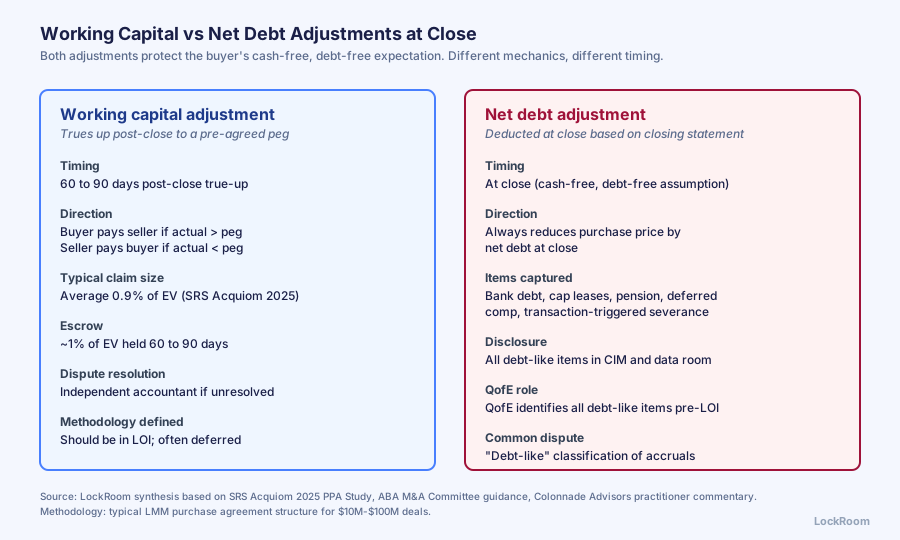
A working capital adjustment is a post-closing purchase price adjustment that reconciles actual working capital at close against a pre-agreed target (the "peg" or "target NWC"). If actual working capital exceeds the peg, the buyer pays the seller the difference. If actual is below the peg, the seller pays the buyer.
The adjustment exists because working capital is the lifeblood of an operating business. The buyer needs the business to come with enough working capital to operate it without an immediate cash injection. The seller needs to be paid for the working capital they are leaving in the business at close.
Without an adjustment, sellers could strip working capital before close (collect aggressively, delay payables) and buyers would inherit a business with insufficient operating capital. Adjustment mechanics prevent that. They also prevent buyers from claiming they were sold a business with deficient working capital.
Why are working capital adjustments now standard?
Per the SRS Acquiom 2025 Working Capital PPA Study covering 1,200 deals, working capital adjustments now appear on over 90% of private M&A deals, up from roughly 50% a decade ago. The mechanism became standard because deal parties learned the consequences of skipping it.
Three forces drove the migration to standard:
- Sophistication of buyer-side advisors. Buyer's QofE providers and financial diligence teams now demand working capital normalization as a standard scope item. The peg flows directly out of the QofE.
- Repeat learnings from disputes. Practitioners who got burned on deals without adjustments learned to insist on them. The consensus norm now expects the mechanism.
- Standard purchase agreement templates. ABA and law firm templates include working capital adjustment language by default. Removing it is now the exception.
The result: any LMM deal closing in 2026 without a working capital adjustment is unusual. Any banker still drafting purchase agreements without it is leaving the seller exposed to retrade or the buyer exposed to working capital deficit.
How is the working capital peg set?
The peg is the agreed-upon target working capital level at close. Setting it is the most important pre-close negotiation a seller's banker manages.
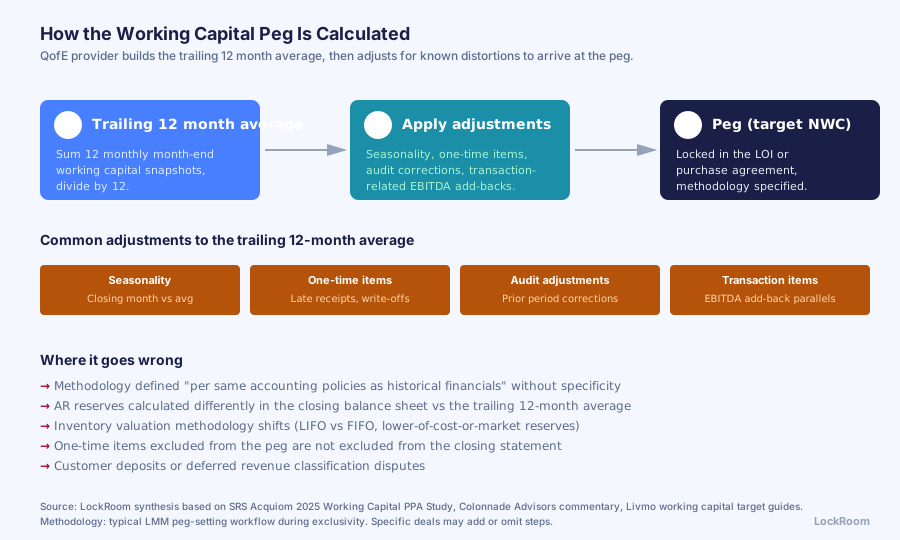
The peg is typically calculated as a trailing 12-month average of monthly month-end working capital snapshots. The QofE provider builds a working capital trend table (sometimes 24 months) and proposes a normalized peg based on the trailing 12-month average, adjusted for specific items.
Common adjustments to the trailing 12-month average:
- Seasonality: high-seasonality businesses see working capital fluctuate; the peg should reflect the closing month, not just the rolling average
- One-time items: if a customer paid late on a specific month, that month should be excluded
- Audit adjustments: prior-period audit corrections should be reflected
- Non-cash items: deferred revenue, deferred rent, certain accruals may be excluded
- Transaction adjustments: items added back in the EBITDA bridge (owner expenses, etc.) often have working capital implications
A typical LMM peg negotiation runs 1 to 3 weeks during exclusivity. The QofE provider proposes; both sides redline; the final peg is documented in the purchase agreement.
How does the true up calculation work?
The true up is the post-closing reconciliation. Per SRS Acquiom 2025, the typical true up window is 60 to 90 days after close.
Day 1 to 60 (typical): Buyer's accounting team prepares the closing balance sheet and computes actual working capital at close per the agreed methodology. The buyer delivers a closing statement to the seller.
Day 60 to 90: Seller reviews. If they accept, the adjustment payment flows. If they dispute, the dispute resolution mechanism in the purchase agreement kicks in.
In 70% of cases per SRS Acquiom 2025, the seller accepts the buyer's calculation. In 30% of cases, dispute resolution kicks in. Median dispute resolution time is two months. Major disputes can extend a year or more.
How big are typical PPA adjustments?
The buyer's initial PPA claim averages 0.9% of transaction value per SRS Acquiom 2025 data. On a $30M deal, that is roughly $270K. On a $50M deal, roughly $450K. 24% of claims exceed 1% of EV, so larger adjustments are not rare.
The median PPA escrow size has grown to about 1% of transaction value in 2024 and 2025, tracking the average claim size. Escrow is typically held 60 to 90 days, sometimes longer.
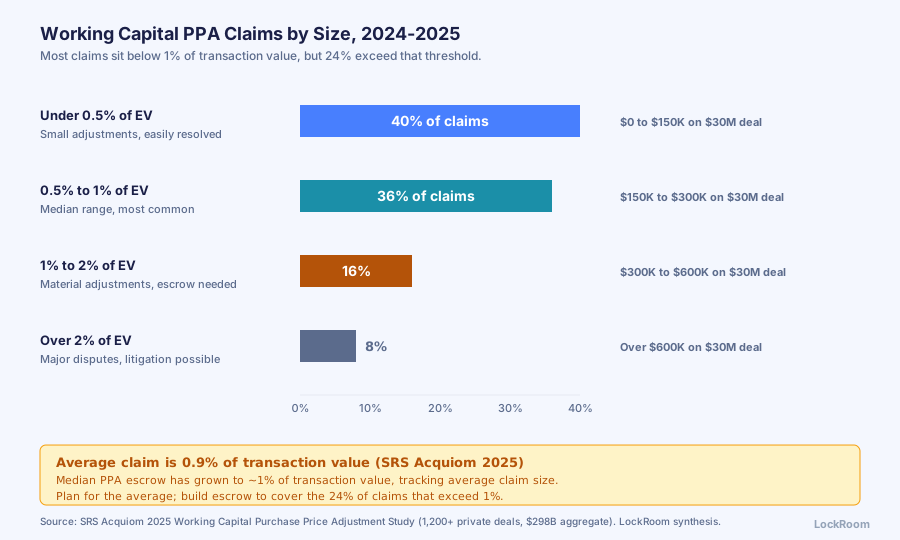
For an LMM banker pricing a deal: assume the buyer will assert a claim of approximately 0.9% of transaction value at the true up. Build that into the seller's expected proceeds calculation. If the claim resolves in line with median outcomes, the seller pays approximately 0.9% of EV back to the buyer 60 to 90 days post-close.
What drives PPA disputes?
The most common dispute drivers in working capital true ups:
- Methodology disagreements. The peg was set per "the same accounting policies as the historical financials" but which policies? Cash vs accrual. Aggressive vs conservative AR reserves. Cap vs operating expense classification. Each ambiguity becomes a dispute hook.
- One-time items. The peg excluded one-time items in the trailing 12 months. The closing statement may reverse those exclusions or apply different judgment.
- Inventory valuation. LIFO vs FIFO, lower of cost or market, obsolescence reserves. These are routine dispute sources.
- Accrued liabilities. When are bonuses accrued? At earned, at declared, at paid? Audit adjustments to bonus accruals can swing working capital materially.
- Customer concentration. A large customer paid (or did not pay) right around close. Including or excluding that receipt affects the calculation by hundreds of thousands.
- Currency and foreign operations. Cross-border deals add FX translation and intercompany payable issues.
How are disputes resolved?
Most purchase agreements specify a multi-step resolution mechanism:
- Negotiation period (30 days typical). The parties meet, exchange working capital schedules, and try to resolve in good faith.
- Independent accountant referral. If unresolved, the parties refer the dispute to an independent accounting firm. The accountant reviews the disputed items and issues a binding determination on each. Cost of the accountant typically split per the proportion of dispute resolved in each side's favor.
- Limited litigation backstop. Some agreements preserve litigation rights for fraud or methodology disputes that fall outside the accountant's scope.
In 70% of cases per SRS Acquiom 2025, the seller accepts the buyer's calculation and step 1 resolves it. In the remaining 30%, the independent accountant typically resolves within 60 to 120 days. Litigation is rare.
What does net debt look like in the same context?
Net debt is the parallel adjustment for indebtedness. The buyer purchases the business "cash-free, debt-free," meaning at close, the buyer takes the business net of debt and excluding cash. A net debt adjustment ensures the buyer is not surprised by debt-like items the seller did not disclose.
Common debt-like items adjusted at close:
- Bank debt and revolvers
- Capital lease obligations
- Pension liabilities
- Deferred compensation owed to employees
- Severance and change-of-control payments triggered by the deal
- Earn-out obligations from prior acquisitions
- Tax liabilities for pre-close periods
- Customer deposits classified as liabilities
The buyer's QofE will identify all such items during diligence. The purchase agreement specifies which are deducted from purchase price at close and which are excluded.
How should sellers protect themselves on PPA?
Five tactical recommendations from practitioner commentary:
- 1. Define methodology in the LOI, not the purchase agreement. Working capital is among the most retrade-prone deal terms because the LOI usually says "to be defined per the same accounting policies." Push for explicit methodology in the LOI: which accounting policies, which add-backs, which exclusions.
- 2. Use the QofE provider's normalized peg. Run the sell-side QofE before going to market. The QofE provider establishes the peg using documented methodology. Bidders see the peg in the data room and bid accordingly.
- 3. Lock the methodology, not the dollar amount. The peg is a number; the methodology is the rules for calculating it. Locking the methodology in the LOI means the closing balance sheet must be calculated the same way as the trailing 12-month average. This eliminates 80% of dispute hooks.
- 4. Require receivables reserves to be calculated identically. AR reserves are a favorite dispute hook. Require historical reserve methodology to apply at close.
- 5. Negotiate the dispute resolution mechanism. Push for a tight independent accountant timeline (60 days) and a binding standard (the agreement, not "fair and equitable"). Vague standards favor the party with more legal resources, which is usually the buyer.
Sector-specific notes
Healthcare services. Receivables aging is critical. Accounts receivable from Medicare/Medicaid have specific timing and reserve patterns. Healthcare-experienced QofE providers handle this; generalist firms often miss it.
Software / SaaS. Deferred revenue is the dominant working capital component. Recognition timing matters. Working capital normalization should reflect deferred revenue mechanics.
Manufacturing. Inventory is the dominant component. Inventory valuation methodology, obsolescence reserves, and physical count timing all become dispute hooks.
Professional services. Work-in-progress (WIP), billed AR, and unbilled AR all behave differently. Most firms use percentage-of-completion accounting; closing balance sheets should reflect that consistently.
Distribution / wholesale. Inventory turns and supplier rebates create unique working capital patterns. Slow-moving inventory and obsolescence reserves are routine dispute sources.
Bottom line
Working capital adjustments are now standard on over 90% of LMM deals. The seller's banker who is not specifying the methodology in the LOI is conceding the most common post-close retrade lever to the buyer.
For sell-side bankers running LMM processes:
- Run sell-side QofE before going to market and use the QofE-normalized peg in the data room
- Define methodology explicitly in the LOI, not "to be defined in the purchase agreement"
- Lock receivables reserves, inventory valuation, and one-time exclusions in writing
- Negotiate a tight 60 day independent accountant timeline with a binding standard
For founders:
- Expect a true up adjustment of approximately 0.9% of EV; build it into your expected proceeds
- Demand the QofE provider walk you through the peg before LOI signing
- Insist on methodology specificity, not just numerical pegs
- Plan for a 60 to 90 day true up window post-close before the deal is fully done
For buyers:
- The peg is a deal term, not just a closing mechanic; lock it in the LOI for your own protection
- Build in escrow at ~1% of transaction value to cover the typical PPA claim
- Use a QofE provider experienced in your target's sector
- Recognize that retrade attempts via PPA after the LOI may damage relationships needed for transition
Related reading
- Working capital adjustments in LMM LOIs companion deal mechanics piece
- Quality of earnings in LMM M&A how QofE produces the peg
- Sell side M&A process timeline where working capital fits in close
- LOI and exclusivity in LMM M&A LOI methodology
- Earnout structure in LMM M&A adjacent deal mechanics
- LMM M&A 2026 outlook pillar back link
Working Capital Escrow Calculator
Plug in your deal size and the calculator estimates expected PPA claim, recommended escrow, and the true up window. Built from SRS Acquiom 2025 distributions. Free Excel download.