

The 2026 Lower Middle Market Buyer Landscape: PE Platforms, Search Funds, Strategics, Family Offices, and Independent Sponsors
Most diversified LMM buyer pool in 20 years. Seven distinct categories now share the share. Different capital structures, different deal speeds, different post-close behavior.
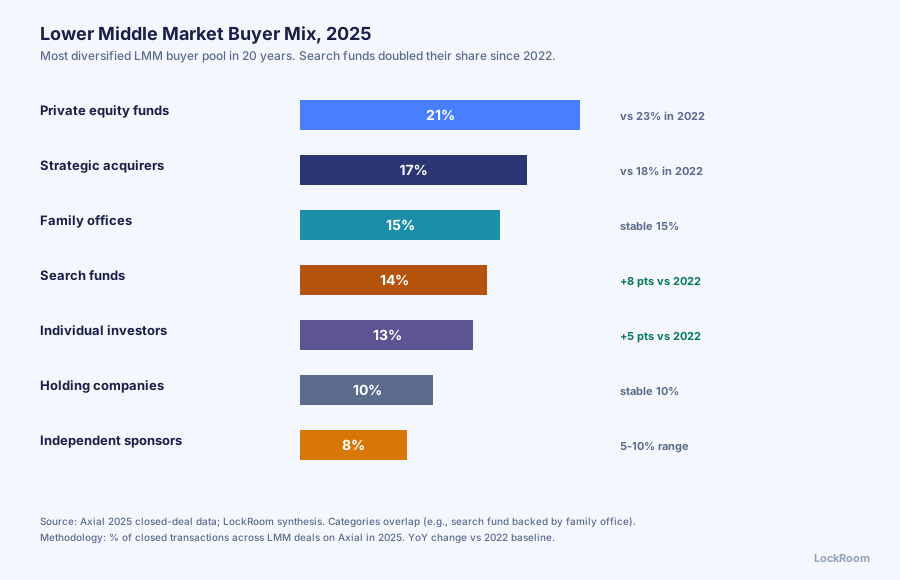
- Most diversified LMM buyer pool in 20 years: PE 21%, Family Offices ~15%, Search Funds 13-14%, Individual Investors 13%, Holding Companies ~10%, Independent Sponsors 5-10%, Strategic acquirers ~15-20% (Axial 2025 closed-deal data).
- Search funds doubled their share since 2022, from 6% to 14% of all LMM closed deals.
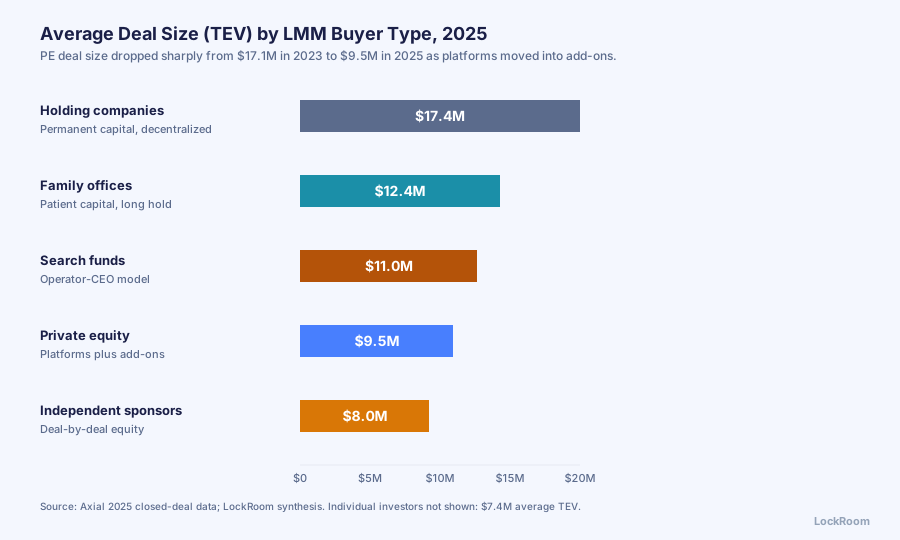
- PE deal sizes dropped from $17.1M (2023) to $9.5M (2025) as platforms moved aggressively into add-on territory. Add-ons now exceed 70% of PE LMM volume.
- 1,200 to 1,400 active independent sponsors per Holland & Knight 2025 research; deal-by-deal equity carries execution risk requiring scrutiny before granting exclusivity.
- Each buyer type has distinct capital structure, deal speed, and post-close behavior. Match buyer types to seller priorities (sale price vs legacy preservation vs speed).
- Modern process letters need to anticipate at least seven buyer categories, not just PE platforms.
- The highest bidder may not be the right buyer. Read incoming bids by capital structure, operating intent, earnout dependency, R&W positioning, and process speed.
Who is buying in the lower middle market in 2026?
The LMM buyer mix is more diversified than at any point since 2010. Per Axial's 2025 closed-deal data covering thousands of LMM transactions:
- Private equity funds: 21% of closed deals
- Family offices: approximately 15% (5-year average)
- Search funds: 13% to 14% (an all-time high, up from 6% in 2022)
- Individual investors: 13%
- Holding companies: approximately 10% (5-year average)
- Independent (fundless) sponsors: 5% to 10%
- Strategic acquirers: balance, approximately 15% to 20%
The numbers do not sum cleanly because Axial counts deals across multiple buyer types and certain transactions involve multiple categories (e.g., search fund backed by family office capital). The directional shift is what matters: PE funds are no longer dominant in LMM, search funds are rising fast, and the long tail of less institutional buyers (individuals, holding companies, independent sponsors) collectively represent a third of all closed deals.
Why does the buyer mix matter for sellers?
Three operational reasons.
Different buyers structure deals differently. A PE platform pays mostly cash with a small earnout and a clean financing source. A search fund relies on SBA financing and seller financing. A family office pays cash but evaluates the asset on a longer horizon. An independent sponsor pays whatever their capital partners will fund. The LOI structure that wins one buyer type loses another.
Different buyers move at different speeds. Strategic acquirers can be slow (board approvals, IC processes, integration planning) but pay strategic premiums. Search funds are fast (single decision maker) but capital constrained. Individual investors are fast and committed but have limited diligence depth. Sell side bankers shaping process letters need to know which buyer types they are designing for.
Different buyers operate the business differently post-close. This matters for sellers who care about legacy, employee outcomes, and earnout payment likelihood. PE platforms cut costs, search funds become operators, family offices preserve, strategics integrate.
Private equity platforms (committed capital funds)
A private equity platform is a fund that has raised committed capital from limited partners and deploys that capital into platform acquisitions plus follow-on add-ons. The dominant LMM buyer type for two decades.
Capital structure. Committed limited partner capital. Typical LMM-focused fund: $250M to $1.5B fund size, 10-year fund life, 2-and-20 fee structure. Investment committee approval required for each transaction. Deals close on the fund's timeline, which is generally fast once IC approved.
Deal size and process. Average platform TEV in LMM was $9.5M in 2025 per Axial, down from $17.1M in 2023. The drop reflects more PE funds using LMM platforms to source add-ons rather than standalone platforms. PE funds active in LMM also pursue the upper LMM ($25M to $100M EV) for full platform investments.
Behavior pattern. Aggressive on price for platforms in markets they like. Aggressive on retrade leverage during diligence. Cleaner LOI structures (lower retention, more cash at close, sometimes R&W insurance). Operations-focused post-close: cost reductions, talent upgrades, add-on acquisitions to scale.
What sellers should know. PE platforms run high-quality but high-friction processes. The retrade pressure is real. Earnouts are negotiated hard and often don't pay full because the buyer is operating the business in ways the seller may not foresee. Best fit when the seller wants liquidity and is comfortable handing over operations.
Private equity add-ons (what changed in 2025)
The most important LMM buyer trend of 2024 and 2025 is the rise of PE add-on activity. PE funds that had previously focused on $50M+ platform deals have moved aggressively into the $5M to $30M range to source add-ons for their existing portfolio companies.
Per CLA Connect's 2026 outlook and Axial 2025 data, add-on transactions now account for over 70% of all PE deal volume in LMM, up from approximately 50% five years ago.
Why it matters for sellers. A PE add-on buyer is structurally different from a PE platform buyer:
- The add-on buyer's process is faster (the IC has already approved the platform, add-ons get streamlined approvals)
- The valuation methodology differs (add-on accretion math, not standalone DCF)
- The integration is more aggressive (the platform absorbs the acquired business)
- Earnouts are less common (add-ons are typically all cash at close)
- The buyer often has specific operational synergies they will pursue (which is what justifies the add-on price)
For sellers, PE add-ons can offer better economics than expected when the seller's business fits a strategic gap in the platform's portfolio. Recognizing add-on buyers early in the process and sizing the bid universe accordingly is part of modern LMM banker work.
Search funds
A search fund is an entrepreneurial vehicle: one or two MBA graduates raise a search budget ($350K to $500K typical) from individual and institutional investors, then spend 18 to 36 months sourcing a single acquisition target. After acquiring, the searcher becomes the operating CEO of the company.
Capital structure. Search funds raise both search capital (the smaller pre-acquisition fund) and acquisition capital (the larger post-LOI fund). Acquisition capital comes from the same investors who funded the search plus mezzanine lenders, SBA loans, and seller financing. Capital stack is typically 30% to 50% equity, 20% to 30% senior debt, 10% to 20% mezzanine, 10% to 30% seller financing.
Deal size and process. Search funds target $5M to $50M EV businesses with $1.5M to $5M EBITDA per the Stanford 2024 Search Fund Study. Median purchase price was $14.4M in the most recent study. Search funds were 13% to 14% of all Axial closed deals in 2025, up from 6% in 2022.
Behavior pattern. Search funds are operator-focused buyers. The searcher is buying a company to run, not to flip. Diligence is deep but personal. Post-close, the searcher replaces the founder as CEO and operates for 5 to 10 years before a secondary sale. Pricing is at market or slightly below for institutional sponsors, sometimes at premium for businesses with strong recurring revenue and aging founders looking for a successor.
What sellers should know. Search funds are excellent buyers for founders who want their business to continue rather than be integrated or stripped. Watch for capital structure clarity: a search fund with strong investor commitments closes reliably; one without is a higher execution risk. Seller financing is common (often 10% to 30% of price) which the seller should price into the comparison.
Family offices
Family offices are private investment vehicles for ultra-high-net-worth families. The 2026 LMM buyer family office universe ranges from single-family offices managing one family's capital ($500M+) to multi-family offices managing pools of capital ($2B+). Some have dedicated private equity teams; others invest opportunistically.
Capital structure. Permanent capital. No fund expiration. No LP redemption pressure. Returns are measured on long horizons, often 10 to 25 years. This is the longest holding period in the LMM buyer universe.
Deal size and process. Average family office TEV was $12.4M in Axial's 2025 data. Family offices represented approximately 15% of LMM closed deals over the past five years. Process speed varies wildly: some family offices are slow (multi-generation decision making, deep relationship-driven diligence) and some are faster than PE (single decision maker, no IC).
Behavior pattern. Family offices typically pay market or slightly below market for businesses they intend to hold for decades. They prefer recurring revenue, asset-heavy businesses with replacement value protection, and businesses with strong moats. Less likely to engineer aggressive earnout structures. Less likely to pursue cost-cutting or platform consolidation post-close.
What sellers should know. A family office is the most "patient capital" option in the LMM buyer universe. Best fit for sellers who care about preserving the business's character. Worst fit for sellers seeking maximum sale price (family offices rarely top auction bids). Family offices often introduce themselves as a possibility before reaching the LOI stage; bankers should map these connections proactively.
Independent sponsors (fundless sponsors)
Independent sponsors are individual investors or small teams that source deals first and raise the equity capital deal by deal afterward. The universe has 1,200 to 1,400 active independent sponsors per Holland & Knight 2025 research and Upstate Capital's ecosystem analysis. Independent sponsors represent 5% to 10% of LMM closed deals.
Capital structure. Deal-by-deal equity raised from a network of family offices, mezzanine funds, and high-net-worth investors. Typical capital stack: 40% to 50% equity from sponsor's investor network, 20% to 30% senior debt, 10% to 20% mezzanine, 10% to 30% seller financing.
Deal size and process. Average independent sponsor TEV was approximately $8M in Axial's 2025 data. Sponsors typically focus on $5M to $30M deals. Process speed depends on the sponsor's investor commitments: some sponsors have warm investor relationships and can execute as fast as committed-fund PE; others are still raising the equity at LOI signing, which carries closing risk.
Behavior pattern. Most independent sponsors are former PE professionals or operators looking to deploy capital with control. They charge a "carried interest" structure to their capital partners (generally 15% to 25% of profits). They often serve in a chairman or board role at the acquired business rather than operating directly.
What sellers should know. Independent sponsors have grown as a buyer category but carry execution risk that does not exist with committed-capital PE. Bankers should scrutinize the sponsor's capital commitments early in the process and require evidence of binding investor commitments before granting exclusivity. Some bankers exclude independent sponsors entirely from competitive auctions; others welcome them but require LOI conditionality language that allows quick switching to backup bidders if financing fails.
Strategic acquirers
Strategic acquirers are operating companies (typically larger than the target) acquiring competitors, suppliers, customers, or adjacent businesses to drive synergy, expand into new markets, or roll up fragmented industries.
Capital structure. Operating company balance sheet. Cash on hand, revolving credit, or new debt issuance. Some strategics also use acquisition stock as currency. Approval flows through corporate development teams and senior leadership; large acquisitions require board approval.
Deal size and process. Strategic deal sizes vary across the full LMM range. Process speed varies: fast strategics (sub-12-week close from LOI) exist alongside slow strategics (24+ weeks). Bigger strategics often have more sophisticated diligence teams that exceed what the target seller has prepared for.
Behavior pattern. Strategics often pay strategic premiums (10% to 30% above pure financial buyer valuations) when the target fills a meaningful strategic gap. Earnouts are common in strategic deals because the strategic can credibly commit to operational milestones. Post-close integration ranges from light (separate brand, limited integration) to aggressive (full absorption, layoffs, brand retirement).
What sellers should know. Strategics are often the highest priced bidders when the strategic logic is real. They are also the most variable on process speed and can be the most disruptive to retain employees post-close. Best fit when the seller's business has clear strategic value for one or more strategic acquirers and the seller is comfortable with full integration outcomes.
Holding companies
Holding companies are corporate structures that acquire and operate businesses without the fund expiration constraints of PE. Examples in the LMM buyer universe range from publicly traded holding companies (e.g., diversified industrials) to private holding companies built specifically for serial acquisition.
Capital structure. Permanent capital plus access to debt markets. No 10-year fund clock. Some holding companies fund acquisitions through earnings of existing portfolio businesses; others raise dedicated acquisition capital.
Deal size and process. Average holding company TEV was $17.4M in Axial's 2025 data, the highest average across all LMM buyer types. Holding companies represented approximately 10% of LMM closed deals.
Behavior pattern. Holding companies blend the patience of family offices with the operational rigor of PE. Most maintain decentralized operating models where acquired businesses retain management and brand. Returns are generated through long-term cash flow rather than exit-driven multiple expansion.
What sellers should know. Holding companies are good fits for sellers who want continuity and have built businesses that benefit from long-term operating focus rather than aggressive growth. Process tends to be deliberate. Pricing is at market. Earnouts are less common.
Individual investors
Individual investors are high-net-worth individuals or families acquiring businesses directly without an institutional vehicle. This category overlaps with search funds but typically refers to investors who have already accumulated wealth and are deploying personal capital to buy a business.
Capital structure. Personal capital plus SBA financing or seller financing. Often acquires using SBA 7(a) loans up to $5M, supplemented with seller notes. Some individual investors form small investor groups that aggregate capital.
Deal size and process. Average individual investor TEV was $7.4M in 2025 per Axial data. Individual investors represented 13% of LMM closed deals in 2025. Sweet spot is $2M to $15M TEV businesses with $500K to $3M EBITDA.
Behavior pattern. Individual investors are operator-focused buyers, similar to search funds. Diligence is personal and often less institutionally rigorous. Speed varies based on the investor's experience. SBA-financed deals carry specific timeline constraints (90+ days for SBA loan approval).
What sellers should know. Individual investors can be the most committed buyers in the LMM universe (they are buying a single business with their own capital) but carry execution risk through financing. Seller financing requests are nearly universal. SBA-financed individual buyer deals are well suited for sellers willing to provide significant seller financing on a secondary note.
How should sell side bankers read incoming bids?
Five questions to ask of every IOI and LOI:
- Capital structure? Committed fund equity is most reliable. Deal-by-deal equity (independent sponsor, individual) carries financing risk. SBA-financed bids carry timeline risk.
- Operating intent post-close? Operator (search fund, individual) preserves business character. Integrator (strategic, PE add-on) absorbs. Holder (family office, holding company) maintains. Match to seller's preferences.
- Earnout dependency? Cleaner LOIs are mostly cash at close. Heavy earnout proposals (>20% of consideration) are payment risk for the seller and should be priced as such (see Earnout structure in LMM M&A).
- R&W insurance positioning? Buyers willing to fund R&W insurance signal they want a clean transaction. Buyers who require seller indemnity are price-disciplined or unsophisticated. See R&W insurance for LMM M&A.
- Process speed they need? Match buyer process speed to seller priorities. A fast seller wants individual investors and search funds; a strategic-premium seller waits for strategics.
Sector-specific buyer preferences
Healthcare services. Strategic acquirers (hospital systems, MSO platforms) plus PE platforms specialized in healthcare (HIG, Webster, Northlane, etc.). Search funds rarely active due to regulatory complexity. See LMM healthcare M&A 2026.
Software / SaaS. PE platforms specialized in software (Vista, Thoma Bravo, Insight, Constellation), strategic acquirers, and a smaller search fund pool. Independent sponsors active. See LMM SaaS M&A 2026.
Manufacturing. Wide buyer mix: PE platforms (industrial-focused funds), strategic acquirers (industry consolidators), family offices (asset-heavy preference fits family office hold thesis), and independent sponsors. Holding companies particularly active.
Professional services. Search funds and individual investors are highly active because operator-led service businesses fit the search fund model. PE platforms also active in larger services deals. Strategic acquirers important for accounting, IT services, marketing services. See LMM professional services M&A 2026.
Building products. Strategic acquirers (industry consolidators) and PE platforms. Less search fund activity. See LMM building products M&A 2026.
Insurance services. Strategic acquirers (broker consolidators) plus dedicated insurance-focused PE platforms. See LMM insurance services M&A 2026.
Industrial services. Strategic acquirers (industry roll-ups) plus PE platforms. Holding companies particularly relevant. See LMM industrial services M&A 2026.
Consumer. Strategic acquirers and consumer-focused PE platforms. Family offices selective. See LMM consumer M&A 2026.
Bottom line
The 2026 LMM buyer landscape is the most diversified it has been in twenty years. Sell side bankers building modern process letters need to think across at least seven distinct buyer categories, each with different capital structures, deal size sweet spots, and post-close behaviors. Sellers running competitive processes will receive bids that look very different on paper but reflect equally serious buyer intent.
For sell side bankers running LMM processes:
- Build buyer universes that span all relevant categories, not just PE
- Recognize that PE add-ons are now the dominant PE category in LMM
- Treat search funds as a serious buyer pool, not a curiosity
- Scrutinize independent sponsor capital commitments early
- Match buyer types to seller priorities (legacy preservation vs sale price vs speed)
For founders preparing to sell:
- Map your business to the buyer types most likely to value it
- Recognize that the highest bidder may not be the right buyer
- Operate with realistic expectations of post-close behavior by buyer type
- Use the diversity of the buyer universe to negotiate better terms
LockRoom data rooms support diverse buyer universes by design. Permission tiered access lets you give different buyer types different views of the data room (e.g., institutional bidders get deeper financial access, search fund operators get broader operational data). Audit logs hold up to scrutiny across every buyer category. If you are running a process and want a data room that handles a heterogeneous buyer pool well, [start a free trial](/) or [book a demo](/).
Buyer Outreach Tracker
Spreadsheet for managing LMM buyer outreach across PE platforms, search funds, strategics, family offices, and independent sponsors. Status, follow ups, NDAs, IOIs, LOIs in one tab. Free Excel.