

Reps and Warranties Insurance in Lower Middle Market M&A: A 2026 Field Guide
What R&W actually covers, what it costs in 2026, when it makes sense for LMM deals, and where it stops working. Built from ABA Deal Points, SRS Acquiom, and broker market data.
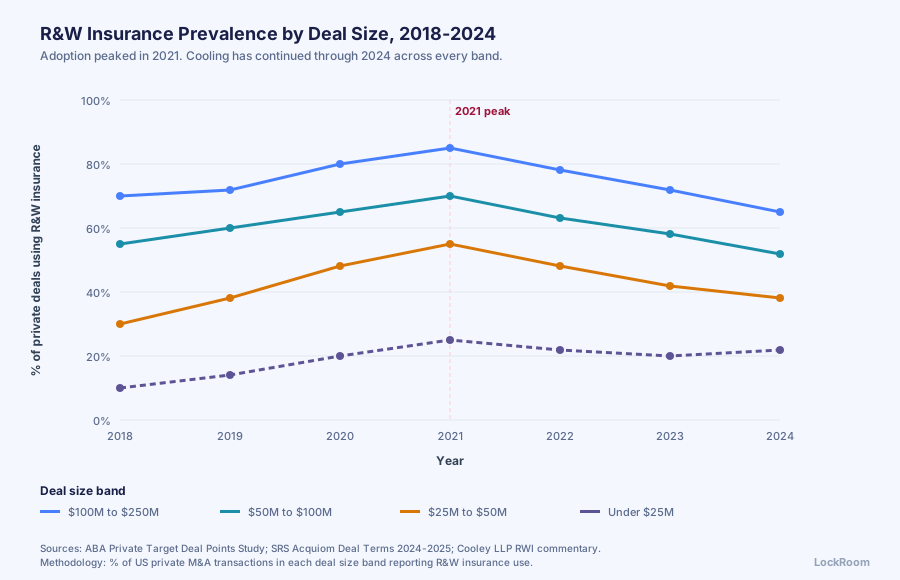
- R&W adoption boomed and is cooling. Peaked at 65% of private target deals in 2021, fell to 55% by 2023, declining further in 2024 across all buyer types (ABA Private Target Deal Points Study).
- Premium softened to 2.0% to 3.0% of policy limit in Q4 2025, down from a historical 3% to 4% range (Horton Group, Woodruff Sawyer, AssuredPartners).
- Retention dropped to 0.5% to 1.5% of EV, with 0.5% increasingly available on cleaner mid-sized deals.
- All-in cost on a $50M deal: $375K to $950K (premium plus retention plus underwriting fees).
- The 2026 LMM auction default: buyer-paid premium, no seller indemnity except fundamental reps and fraud.
- R&W is now standard for $25M+ deals but the "always required" framing of 2021 is gone. The product still pencils on most LMM deals; the seller's banker should push it but recognize buyer flexibility.
- Some PE buyers negotiate "as if R&W" but skip the policy at close to save the premium. Read the LOI carefully.
What is reps and warranties insurance?
Reps and warranties insurance is a policy that covers the buyer (or, less commonly, the seller) against breaches of representations and warranties in the purchase agreement. If the buyer discovers post close that the seller misrepresented the business, the insurance pays the loss instead of the seller.
In a traditional deal without R&W insurance, the seller's reps and warranties are backed by an indemnity (typically capped at 10% to 15% of purchase price) and an escrow holdback (typically 5% to 10% of purchase price). Recovery flows from escrow first and the seller second. With R&W insurance, that recovery mechanism is replaced. The buyer recovers from the policy. The seller takes home a higher percentage of cash at close because escrow shrinks or disappears and the indemnity tail shortens.
There are two structures:
Buy side R&W is the dominant structure in 2026 lower middle market deals. The buyer is the named insured. The buyer's deal team underwrites. Coverage is for breaches the buyer discovers after close.
Sell side R&W is less common. The seller is the named insured. Coverage protects the seller against indemnification claims from the buyer. Used when the seller has a specific reason for first dollar protection, often a private equity exit where the sponsor wants a clean break.
Most of this piece assumes buy side unless stated otherwise.
Why did R&W insurance boom, then cool?
Five forces drove the migration. The boom peaked in 2021. Each force is still alive in 2026, but the second order effects (premium softening, broader carrier appetite, more standardization) ate into the appeal at the margin.
Sellers want a clean exit. Founders selling want cash at close, not a 10% holdback for 18 months and a 15% indemnity tail for 24 months. R&W lets them walk with more cash and less ongoing exposure. Still true. Still the strongest seller argument.
Buyers want certainty of recovery. A solvent insurer is a more reliable counterparty than a wind down fund or a former founder counter party two years post close. This matters most in private equity to private equity transactions where the seller is a fund that may be dissolving by the time a claim emerges. Still true; PE buyers maintained higher adoption rates than strategics through 2023, though both have declined.
Premiums dropped meaningfully. Through the late 2010s premiums fell from roughly 5% to 3% as more carriers entered the market. They softened further during the soft cycle of 2020 to 2021. Carriers tightened in 2022 to 2023 as claims activity rose. By Q4 2025, premiums settled in the 2.0% to 3.0% range of policy limit, with some carriers quoting as low as 2.5% on clean deals (per Q4 2025 market commentary from Horton Group, AssuredPartners, and Woodruff Sawyer).
Auction dynamics demand it. In a competitive process, the buyer offering a clean R&W structure wins on terms even when not winning on price. Sell side bankers shape process letters around R&W because it produces better headline numbers and cleaner closes. Still true, but the dynamic shifted: in cooler M&A markets (2023-2024) buyers reclaimed leverage and some declined to absorb the premium.
Smaller deals can now access it. Carriers that historically required $50M+ enterprise value have moved down market. As of 2026 several carriers and managing general agents write policies on deals with $20M to $30M enterprise value. The 2026 economic floor is roughly $20M, with rare exceptions below.
The cooling: the ABA Private Target Mergers & Acquisitions Deal Points Study shows R&W adoption fell from a 65% peak in 2021 to 55% in 2023, with declines continuing in 2024 across all buyer types and deal sizes. Practitioners report a new pattern: PE buyers negotiate the deal "as if R&W is in place" but at close decide to self insure rather than pay the premium.
When does R&W insurance make sense?
The decision is rarely yes versus no. It is what structure and who pays.
Strong fit for R&W insurance:
The deal has $25M to $250M enterprise value, runs as an auction or competitive process where the seller's banker is shaping bid terms, has a private equity seller exiting (sponsor wants a clean break) or a strategic buyer with sufficient diligence depth to underwrite the policy, and has no known issues that would be carved out of coverage anyway.
Weaker fit:
Deals below $20M (premiums and retentions do not pencil), industries with known concentration risks underwriters will not cover (cannabis, certain healthcare verticals), deals with significant known issues that would be excluded from coverage, and deals where the seller has reasons to retain indemnity exposure (e.g., management is rolling significant equity and wants to demonstrate confidence).
Edge cases:
Asset deals can use R&W though the carve outs are different than stock deals. Cross border deals add complexity (which jurisdiction's law governs the policy). Earnouts complicate the buyer's interest in claiming on the policy because claims can disturb post close performance metrics.
How much does R&W insurance cost in 2026?
Three numbers matter: limit, retention, and premium.
Limit (the ceiling on what the policy pays). Typically 10% to 20% of enterprise value, averaging around 15% per Q4 2025 market reports. A $50M deal carries a $5M to $10M policy limit, with $5M to $7.5M most common. The limit is sized to cover the cap that would have applied to seller indemnity in a non insured deal.
Retention (the deductible). Typically 0.5% to 1.5% of enterprise value, with 0.5% increasingly available on cleaner mid sized deals (down from the historical 1% standard). A $50M deal usually carries a $250K to $750K retention. The retention is the buyer's first dollar exposure before the policy responds. In many deals the retention is split between buyer and seller via an escrow or a half retention structure.
Premium (one time cost). 2.0% to 3.0% of policy limit in Q4 2025 per Horton Group's RWI Market Update, AssuredPartners' 2025 RWI commentary, and Woodruff Sawyer's premium tracking. Some carriers quote as low as 2.5% on clean deals; rates have softened from the historical 3% to 4% range. A $5M policy in this range costs $100K to $150K, paid at policy bind (close).
There are also underwriting fees. The carrier's outside counsel reviews deal documents and the buyer's diligence reports. Underwriting fees run $25K to $50K, depending on transaction size and complexity. These are separate from the premium and are paid upfront whether or not the policy is bound.
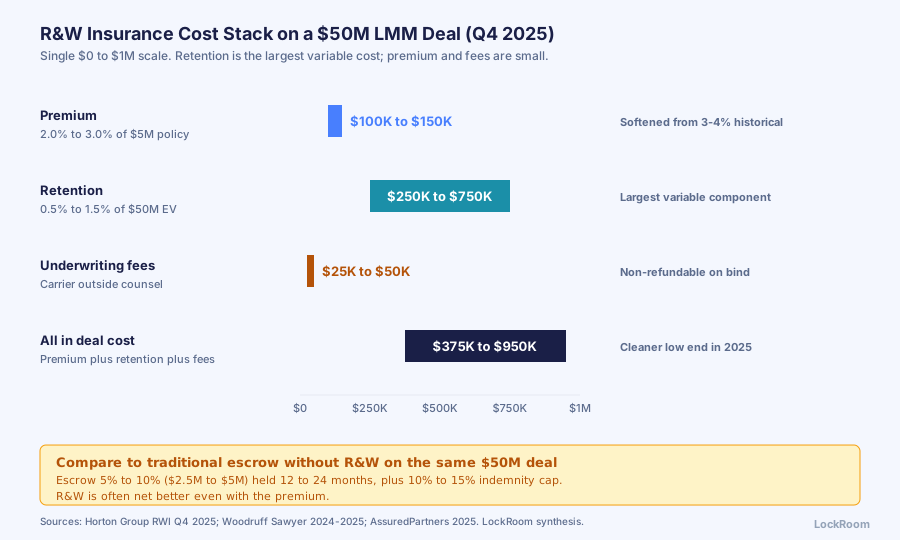
For comparison, traditional escrow without R&W on a $50M deal: 5% to 10% escrow ($2.5M to $5M) held for 12 to 24 months, plus 10% to 15% indemnity cap ($5M to $7.5M). The seller's effective cost is the time value of escrowed capital plus the residual indemnity exposure. R&W is often net better for the seller even with the premium, which is why the product has not gone away despite the cooling adoption rates.
How long does R&W underwriting take?
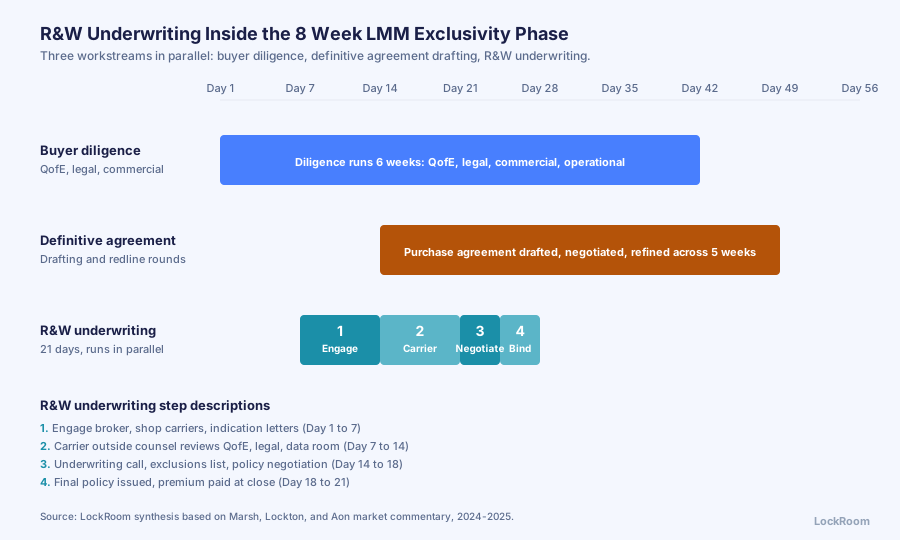
R&W underwriting runs in parallel with the buyer's diligence during exclusivity. Standard timeline is 2 to 3 weeks from broker engagement to bound policy, assuming the buyer's diligence is complete.
Day 1 to 5: engagement and initial review. The buyer's deal team engages a broker (Marsh, Aon, Lockton, Willis, or others). The broker shops the deal to 3 to 5 carriers. Carriers issue indication letters with proposed terms (limit, retention, premium, exclusions).
Day 5 to 10: carrier selection and primary diligence. The buyer selects the lead carrier based on terms. The carrier's outside counsel begins primary diligence: reads the buyer's QofE, legal diligence reports, the data room, and the draft purchase agreement. The carrier identifies areas where they want additional comfort.
Day 10 to 14: underwriting call. A 60 to 90 minute call between the carrier's outside counsel, the buyer's deal team, the buyer's outside counsel, and the seller's outside counsel. The carrier asks targeted questions about specific reps. This is where issues that will be excluded from coverage get flagged.
Day 14 to 18: policy negotiation. The carrier issues the draft policy. Buyer's counsel negotiates the exclusions, the warranties wording, the survival period, and the materiality scrape. Most deals require 1 to 2 rounds of policy negotiation.
Day 18 to 21: binding. Final policy issued. Premium paid at close. Policy effective as of the closing date.
The data room matters here. Carriers and their outside counsel access the data room directly during underwriting. Bankers who run organized data rooms with clean folder structure and proper permission tiers reduce underwriting time by 3 to 5 days versus poorly organized data rooms. This is one of the operational reasons LockRoom focuses on permission tiering and clean folder structure for underwriter access. See Sell side data room folder structure.
What does R&W insurance cover?
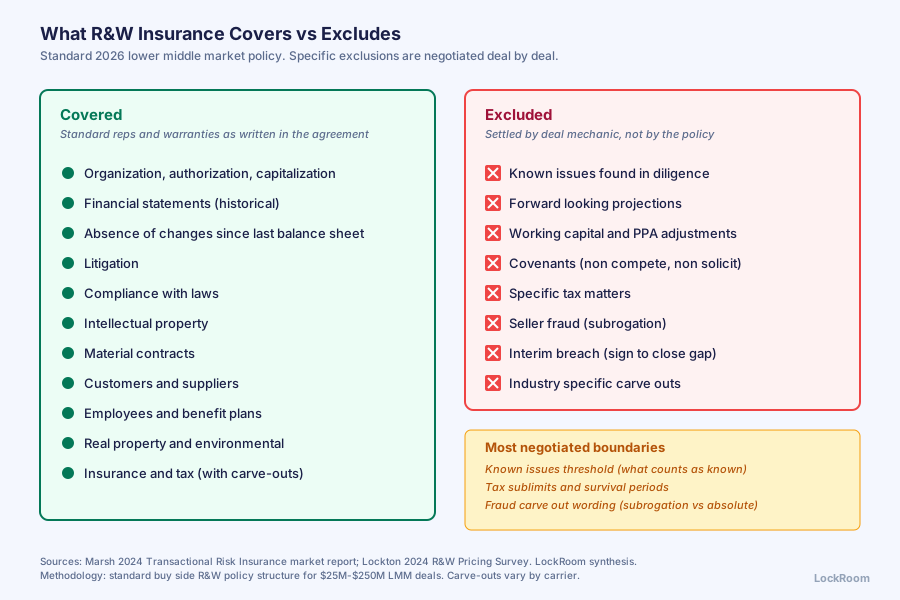
R&W insurance covers breaches of the seller's reps and warranties as written in the purchase agreement. Standard reps include organization and authorization, capitalization, financial statements, absence of changes since the most recent balance sheet, litigation, compliance with laws, tax (with carve outs), intellectual property, material contracts, customer and supplier relationships, employees and benefit plans, real property, environmental matters, and insurance.
The policy covers losses arising from breaches: damages, defense costs, and certain consequential losses up to the policy limit, after the retention is satisfied.
What does R&W insurance NOT cover?
Coverage exclusions are the most negotiated part of any R&W policy. Standard exclusions include:
Known issues. Anything identified in diligence (the buyer's QofE, legal review, environmental study) is excluded. The policy covers unknowns. Issues found during diligence have to be addressed via price adjustment, specific indemnity, or escrow.
Forward looking projections. Statements about future performance are not covered. Only statements of historical or current fact at the time of close.
Purchase price adjustments and working capital. True up disputes are settled per the agreement, not the insurance.
Covenants. Covenants by the seller (non compete, non solicit, transition services obligations) are not insured.
Specific tax matters. Pre close tax positions and certain transfer pricing issues are typically excluded or sublimited.
Fraud. Some policies exclude seller fraud (the buyer recovers from the seller). Some policies cover the buyer's loss from seller fraud (the carrier subrogates against the seller). Read the wording.
Interim breach. Reps re-made at close are subject to a knowledge qualifier. Issues that arise between signing and close that the buyer knew about are usually excluded.
Buyer perspective: why pay for R&W?
R&W is a real cost line in the buyer's deal model. $375K to $950K all in on a $50M deal is meaningful. Buyers still pay because of:
Faster, cleaner close. Auction processes increasingly require R&W to be competitive.
Recovery certainty. A solvent carrier is more reliable than a fund in dissolution or a founder counter party.
Reduced friction with the seller. A cleaner break means easier transition relationships.
Board / IC comfort. Private equity buyers often need R&W to satisfy investment committee on deal terms.
Buyers push back on:
Cost. On a tight bid, $200K of premium can be the difference between a winning and losing offer.
Coverage gaps on known issues. The policy does not insure what diligence found, so disputed issues still need a deal mechanic.
Underwriting friction. Adds 2 to 3 weeks to the close timeline if not managed in parallel.
Seller perspective: why R&W is the highest leverage ask
R&W is the highest leverage deal terms request a seller's banker can push.
What the seller gets: higher cash at close (smaller or zero escrow), shorter indemnity tail (often eliminated entirely), clean exit (no 18 month worry about escrow release), and better optics in headline price (more cash up front).
What the seller gives up: some payment of the premium (negotiated, often split or fully borne by buyer in competitive auctions), cooperation with carrier underwriting (calls, document access), and diligence transparency (the carrier reads everything).
The dominant structure in 2026 lower middle market auctions is "buyer pays the premium, no seller indemnity except fundamental reps and fraud." This is what the seller's banker should push for, and what the buyer's deal model should anticipate.
Sector specific notes
Healthcare. Carriers price R&W higher for healthcare due to regulatory exposure (Stark, Anti Kickback, billing compliance). Some sub sectors (compounding pharmacies, behavioral health, certain specialty providers) attract premium loads of 4% to 5%. Underwriters require deeper diligence on coding, billing audits, and compliance programs. See LMM healthcare M&A 2026.
Software / SaaS. Standard coverage. Underwriters focus on IP ownership, open source compliance, customer contracts, data privacy (especially anything with EU customers). See LMM SaaS M&A 2026.
Manufacturing. Standard coverage. Underwriters focus on environmental matters, product liability, customer concentration. Premium loads modest unless the manufacturer has significant environmental footprint.
Insurance services. Carriers underwrite carefully due to regulatory complexity. Underwriting can extend timelines.
Financial services. Many carriers exclude or sublimit regulatory matters. Specific regulatory carve outs are common.
Cannabis. Most carriers will not bind. The few that do charge significant premium and exclude most regulatory and tax matters.
How does the data room affect R&W?
Data room organization affects two things in R&W: underwriting timeline and policy exclusions.
Timeline. Carriers and their outside counsel access the data room throughout underwriting. Clean folder structure and proper permission tiering means they find what they need without back and forth requests. Bankers who run their data rooms tightly compress underwriting from 3 weeks to 2.
Exclusions. Anything the carrier sees and flags becomes a candidate for exclusion. Bankers who organize the data room around the buyer's diligence workflow (so the carrier sees information in context) often get more permissive policies than bankers who dump documents without organization.
This is one of the operational ways the data room shows up on the deal P&L. A well organized room saves the seller premium dollars and reduces the exclusions list. A messy room costs both.
Bottom line
Reps and warranties insurance is now standard in 2026 lower middle market M&A above $25M enterprise value. The seller's banker who is not pushing R&W into auction terms is leaving cash and certainty on the table. The buyer's deal model should anticipate R&W cost as a line item. The data room should be organized with the carrier as a stakeholder.
For sell side bankers running LMM processes: push R&W into the process letter and second round bid criteria, demand buyer paid premium in competitive auctions, get the broker engaged early (week 1 of LOI exclusivity) so underwriting parallels diligence, and pre review your data room as if a carrier will access it; remove dead documents and confirm permission tiers.
For buyers: anticipate $375K to $950K all in on $50M deals, negotiate retention and exclusions hard at the indication letter stage, and coordinate broker engagement and QofE to compress timeline.
For founders: do not let an auction close without R&W on the table. A buyer who refuses R&W is usually not the best partner anyway.
LockRoom data rooms are built for the way 2026 LMM diligence and underwriting actually run. Permission tiers, structured folders, audit logs that hold up to carrier review. If you are running a process and want a data room that reduces R&W underwriting friction, [start a free trial](/) or [book a demo](/).
Data Room Folder Structure Template
Skip the "what folders should we have" debate. The LockRoom folder structure template maps to the standard buyer diligence request list. 12 top level folders, 80+ subfolders.