

Investor Presentation Template: A Free Sell Side Pitch Reference
20 slides built with LMM private equity operators. The structure that wins mandates from founders and PE owners. Built for the only question that matters in the pitch: why you over the other firm.
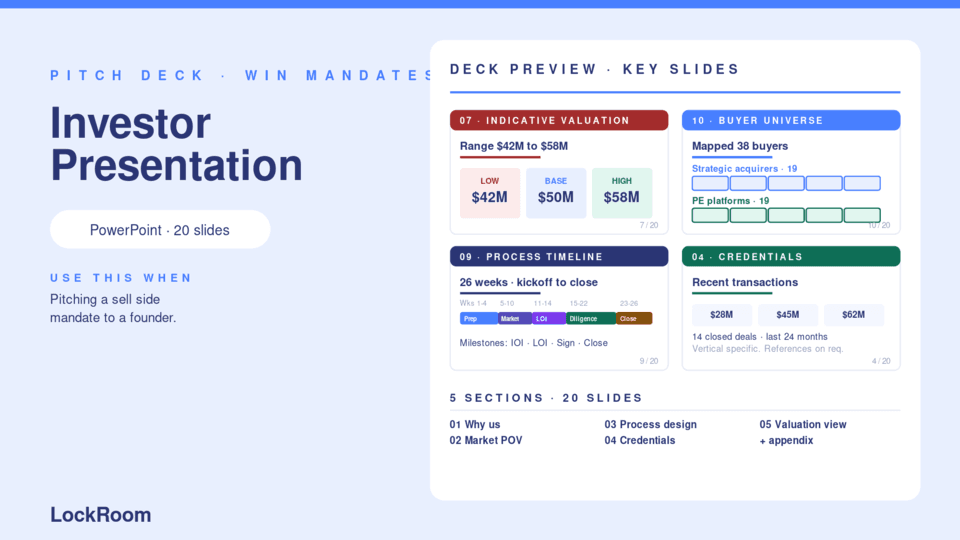
- Process overview slide that frames the engagement timeline and key milestones
- Market analysis section with comp set framework and recent transaction references
- Buyer universe map structured for both strategic and PE buyer outreach
- Indicative valuation framework with range methodology and sensitivity logic
- Team capability slides with prior LMM transaction credentials and named deals
- Engagement summary with fee structure, timeline, and deliverables transparency
What separates a winning pitch from a losing one
Specificity. Generic capabilities decks lose. Specific work decks win.
The founder evaluating banker pitches asks one question above all others: has this banker done the work to understand my specific business and market? The version of the deck that demonstrates the work wins. The version that pitches generic capabilities loses.
The template forces specificity through structure. Every section requires the banker to fill in named buyers, named comps, named recent transactions. The blank fields cannot be left generic; they must be customized.
The 20 slide structure
- Cover. Banker firm, deal codename or sector, date.
- Agenda. Sets meeting expectations.
- Executive summary. One slide thesis on why this banker for this deal.
- Market overview. Sector dynamics, growth, competitive landscape.
- Comparable transactions. Specific recent LMM deals in the seller's sector with multiples.
- Comp set. Public and private comparable companies for valuation framework.
- Indicative valuation. Range methodology, sensitivity to key drivers.
- Process strategy. Auction vs negotiated, how the banker would run it for this seller.
- Process timeline. Week by week from kickoff to close, typical 26 to 30 weeks.
- Buyer universe overview. Strategic vs PE breakdown, total addressable buyer count.
- Strategic buyers. Named list with rationale per buyer.
- PE buyers. Named list with rationale per buyer.
- Marketing materials plan. Teaser, CIM, data room, management presentation strategy.
- Diligence preparation. Sell side QofE recommendation, data room readiness.
- Negotiation strategy. LOI tactics, exclusivity terms, leverage management.
- Team. Named partners and associates working the deal, roles and responsibilities.
- Track record. Recent named transactions in the same sector or deal size.
- References. Two or three founder references the banker has closed for.
- Engagement summary. Fee structure, retainer, success fee, timeline, deliverables.
- Next steps. What happens after the pitch meeting.
The buyer universe slide
The single most important slide. Founders care most about who the banker can credibly bring to the table. A specific list of 30 to 50 named buyers wins. A generic capabilities slide loses.
The template includes a structure for the buyer universe slide:
- Strategic buyers, with one line each on the buyer's recent acquisition history and stated thesis.
- PE platforms, with one line each on the platform's focus and recent deals in the sector.
- Family offices and HNW buyers, when relevant.
- International buyers, when the seller has cross border attractiveness.
The banker who can fill this slide with named buyers and rationale wins. The banker who shows a logo grid of generic PE firms loses.
The indicative valuation slide
Founders want to know the number. Refusing to share a range reads as evasion or lack of preparation. The template provides a valuation framework that ranges thoughtfully:
- Low case based on conservative comps and discounted projections.
- Base case using median comps and base projections.
- High case using premium comps and stretch projections.
- Sensitivity analysis showing how the range moves with EBITDA or revenue assumptions.
The template prevents the banker from overcommitting on valuation while still showing thoughtfulness. Founders respect a thoughtful range; they distrust a banker who refuses to engage with the question.
Who should use the template
Boutique investment bankers pitching LMM founders or PE owners on sell side mandates.
Sell side associates and analysts drafting pitch decks under partner review.
Solo M&A advisors who pitch infrequently and want a tested structure.
Pair this with The CIM Template Outline for the document the banker will produce after winning the mandate, and The Buyer Outreach Tracker for managing the buyer universe outreach during the process.