

Earnout Structuring Matrix: A Free LMM M&A Reference
Common payout tiers, milestone definitions, contingent consideration ranges, and protective seller-side language. The full LMM earnout reference in one document.
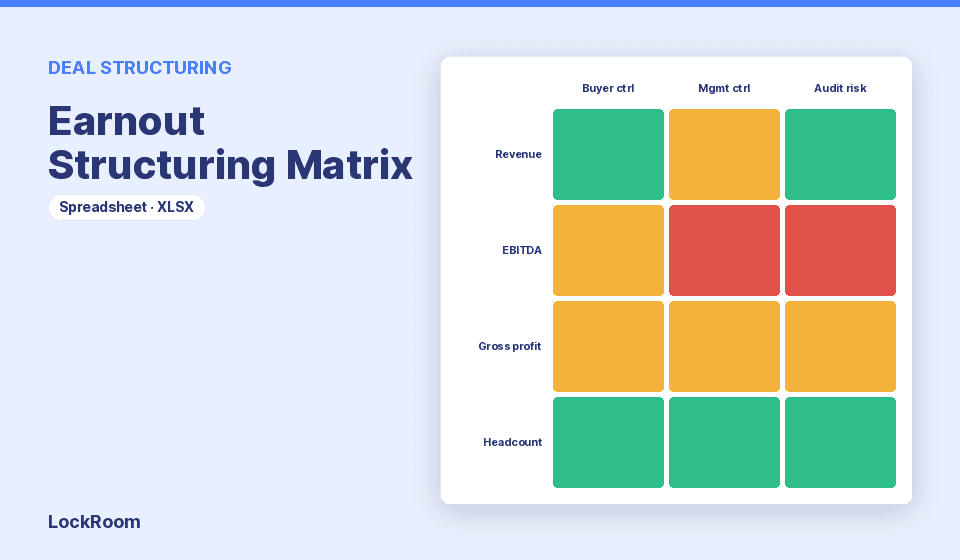
- 4 earnout structures scored across 3 dimensions (buyer control, management control, audit risk)
- Sample 30 percent rule scenarios showing realized payouts vs headline
- Common buyer pushback playbook with redline language
- Decision flow for picking the structure that fits the deal
What's in the matrix
The PDF contains three reference matrices plus a sell-side negotiation playbook:
Matrix 1: Earnout metrics by manipulation risk. Six metric types (EBITDA, revenue, customer retention, milestones, synergy, gross profit) compared on manipulation risk, seller-friendliness, and use cases.
Matrix 2: Recommended structures by deal scenario. Eight scenarios (PE platform, strategic acquirer, family office, search fund, healthcare, SaaS, manufacturing, professional services) with recommended metrics, periods, and rationale.
Matrix 3: Required seller protections by structure. Critical / important / less critical / N/A ratings for nine protection mechanisms (methodology, floor, anti-dilution, audit rights, acceleration, cap on add-back disputes, cost allocation, accounting policies) across four metric types.
Negotiation playbook. 10 tactical recommendations for sell-side bankers and founders.
Why earnouts matter
Per SRS Acquiom analysis, LMM earnouts pay materially less than the headline suggests. Realistic expected value lands between 30% and 60% of the headline amount, depending on structure.
A founder told they will get $20M ($15M base + $5M earnout) often ends up around $17.5M after the earnout shakes out. The structure determines whether they get $16M (poor structure) or $19M (strong structure).
The matrix maps structure choices to outcomes:
- Customer retention earnouts pay 60-80% of headline because retention is hard for buyers to manipulate
- Revenue earnouts pay 50-70% because recognition timing is the only meaningful manipulation lever
- EBITDA earnouts pay 30-50% because corporate cost allocation, shared services, and accounting policy choices give buyers many manipulation levers
- Milestone earnouts vary widely based on milestone specificity and buyer commitment
How to use the matrix
Step 1: Identify your deal scenario in Matrix 2. Note the recommended metric and period.
Step 2: Cross-check Matrix 1 to understand the manipulation risk and seller-friendliness of the recommended metric.
Step 3: Use Matrix 3 to determine which protections you must negotiate for the chosen metric. Critical-rated protections are non-negotiable for sellers; important-rated protections should be pushed for; less-critical protections are nice-to-have.
Step 4: Apply the negotiation playbook to your LOI and purchase agreement drafting.
Step 5: Validate the structure against the realistic 30%-60% outcome range. If your earnout is structured to pay near the high end, you've structured well. If structured to pay near the low end, push back during negotiation.
Who should use the matrix
Sell-side bankers structuring earnouts in LOI negotiation and purchase agreement drafting.
Founders evaluating buyer offers that include earnout components, understanding what the headline number really means.
Sell-side counsel drafting earnout language that protects the seller through the earnout period.
Buyers designing earnouts that align seller incentives with deal performance without overcommitting to outcomes the buyer can't control.
The 30% rule
The single most important guideline: total earnout should not exceed 30% of total deal consideration.
Math: a $20M deal with $14M base + $6M earnout has 30% in earnout. The seller takes $14M cash at close ($14M of certainty) and bets on $6M of contingent payments that might pay $1.8M to $4.8M (30%-80% of headline depending on structure).
A $20M deal with $10M base + $10M earnout has 50% in earnout. The seller takes $10M cash at close and bets $10M on contingent payments that might pay $3M to $8M. The seller is effectively financing the buyer at zero interest for 1-3 years.
Maximize base, minimize earnout. If the buyer insists on a large earnout, the deal is structured against the seller.