

Selling Your Business to a Search Fund: A Founder's Guide
Search funds buy small businesses one at a time. Median price $14.4M at 7.0x EBITDA. Aggregate IRR 35.1% across 681 funds. What founders should know before signing.
- Search funds buy small businesses one at a time. A two-person MBA-led team raises a search budget, sources for 18-36 months, and acquires a single target. After close, the searcher becomes operating CEO.
- Median search fund purchase price: $14.4M at 7.0x EBITDA per Stanford GSB 2024 Search Fund Study (down from $16.5M in prior years due to tighter financing).
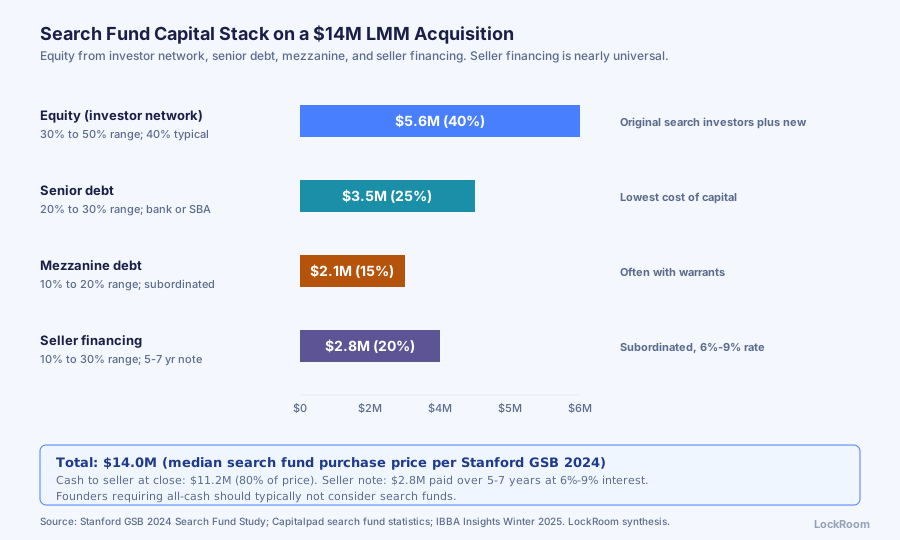
- Capital stack: 30%-50% equity from investor network, 20%-30% senior debt, 10%-20% mezzanine, 10%-30% seller financing. Seller financing is nearly universal.
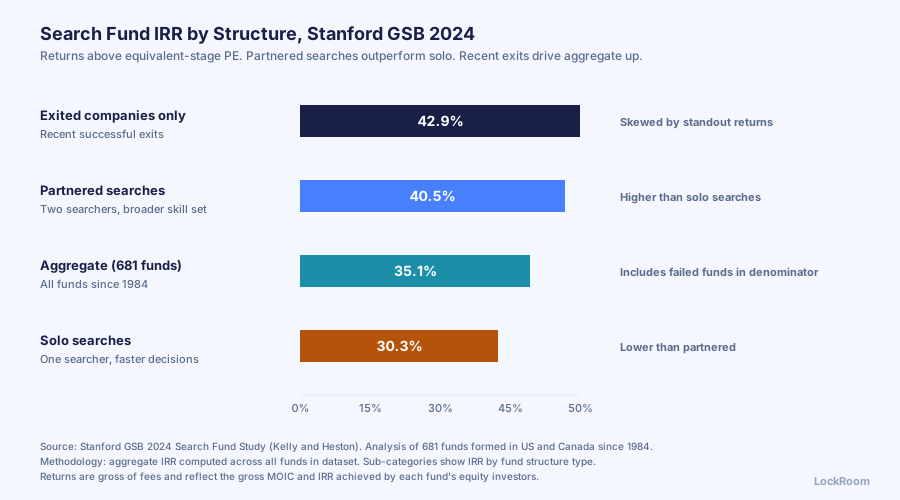
- Aggregate IRR: 35.1% across 681 funds; partnered searches 40.5%, solo searches 30.3%, exited companies 42.9% (Stanford 2024).
- Best fit for sellers: founders selling to retire who want their business preserved and operated, not integrated or stripped.
- Watch capital commitments closely. Search funds without binding investor commitments at LOI carry execution risk; require evidence before granting exclusivity.
- Bottom line: search funds are excellent operator-buyers but rarely top-bid in competitive auctions. They win when the seller values legacy preservation over price maximization.
What is a search fund?
A search fund is an entrepreneurial vehicle in which one or two MBA graduates raise a search budget from individual and institutional investors, spend 18 to 36 months sourcing a single acquisition target, and then operate the acquired business as CEO post-close.
The model breaks into two stages:
Stage 1: The search. The searchers raise a "search fund" of $350K to $500K to pay themselves a modest salary and cover sourcing costs. They typically have 18 to 36 months to find a target. Investors who fund the search get the right (and obligation) to participate in the acquisition financing later.
Stage 2: The acquisition. When the searcher identifies a target, the acquisition financing closes: equity from the original search investors plus mezzanine and senior debt. The searcher becomes operating CEO.
Search funds target small profitable businesses. Per Stanford 2024 Search Fund Study: $5M to $50M enterprise value, $1.5M to $5M EBITDA, often in unsexy sectors (industrial services, manufacturing, distribution, healthcare services, software). Median purchase price was $14.4M at a 7.0x EBITDA multiple, down from $16.5M in prior years as tighter SBA-style financing pulled deal sizes lower.
How do search fund acquisitions get capitalized?
Search fund acquisitions use a blended capital stack. Per practitioner reports and industry publications, a typical $14M search fund acquisition is financed with:
- 30% to 50% equity from the search fund's investor network (the same investors who funded the search, plus sometimes new equity partners)
- 20% to 30% senior debt (bank debt, sometimes SBA-backed)
- 10% to 20% mezzanine debt (subordinated, often with warrants)
- 10% to 30% seller financing (the seller takes a note for part of the purchase price)
The capital stack is meaningful for sellers because it determines:
- Speed of close. Searchers with strong investor commitments can close in 60 to 90 days. Searchers still raising at LOI signing can drag to 120+ days.
- Probability of close. Searchers who have not raised the equity carry execution risk. Some deals fall through at the financing stage.
- Seller financing exposure. Most search fund deals require seller financing. The seller becomes a creditor of the acquired business for 3 to 5 years post-close, with the searcher's operating performance determining repayment.
What's the seller financing typical structure?
Seller financing in search fund deals is not optional. It is the norm.
The seller takes back a note (the "seller note") for 10% to 30% of the purchase price. Typical terms:
- Term: 5 to 7 years
- Interest rate: 6% to 9% in 2026 (lower than mezzanine, higher than senior debt)
- Subordination: subordinated to senior and mezzanine; senior to equity in the cap stack
- Amortization: often interest-only for years 1-2, then amortizing
- Acceleration: triggers if the searcher exits or sells the business
- Personal guarantees: occasionally, depending on the searcher's net worth
The economics: a $14M deal with 20% seller financing means the seller takes home $11.2M cash at close plus a $2.8M note. The note pays interest and amortizes over 5 to 7 years. The seller's effective return is the interest rate, which is often above market for similar credit quality.
The risk: if the searcher's operating performance is weak, the seller may not get fully paid on the note. Subordination means senior and mezzanine get paid first. Sellers should price this risk explicitly when comparing search fund offers to all-cash strategic offers.
What is the IRR profile of search fund deals from the buyer side?
Per Stanford GSB 2024 Search Fund Study covering 681 funds since 1984:
- Aggregate IRR across all funds: 35.1%
- Exited companies only: 42.9% (recent exits including standout returns)
- Partnered searches (two searchers): 40.5%
- Solo searches (one searcher): 30.3%
These returns are above what equivalent-stage PE achieves, which explains why search funds attract serious investor capital. A founder selling to a search fund is selling to a buyer whose investors expect those returns. That has implications for purchase price negotiation: search funds typically pay market or slightly below market because their investors require return, not because they don't value the business.
When does selling to a search fund make sense for a founder?
Search funds are an excellent fit when:
You are retiring and want the business preserved. The searcher will operate the business; they are not buying it to flip or strip. Most searchers hold for 5 to 10 years, sometimes longer.
Your business has $1.5M to $5M EBITDA. Below this range, the deal economics are tight. Above $5M EBITDA, you are typically in PE territory where committed-capital buyers compete.
You have a clear succession problem. Family members aren't taking over. Senior managers don't want to buy. A searcher steps in as the new operating CEO with operational urgency.
You can wait 60 to 120 days for close. Search funds are not the fastest buyers. If you need cash quickly, a strategic acquirer or PE platform may be faster.
You're willing to take seller financing. If you require all cash at close, you eliminate most search fund options. Strategic acquirers and PE platforms more often pay all cash.
You value the founder-to-operator transition. The searcher becomes the new CEO. Most searchers spend 6 to 18 months in deep transition with the founder. If you want that transition relationship, search funds offer it; PE platforms typically don't.
Search funds are a poor fit when:
- You need to maximize headline price (PE platforms and strategic acquirers usually bid higher)
- You want all cash at close with no seller financing
- Your business is below $1.5M EBITDA (deal economics tight) or above $5M EBITDA (PE platforms compete)
- You want a strategic premium for fit with a larger acquirer (search funds don't pay strategic premiums)
- The searcher cannot demonstrate binding investor commitments (execution risk)
What should sell-side bankers verify before accepting a search fund LOI?
Bankers running competitive processes that include search fund bidders should run a capital commitment check at the IOI stage and hard-verify at the LOI stage.
At IOI:
- Identify the searcher's investor network. Stanford 2024 Search Fund Study lists the active investors; the searcher should name who is funding their search and who is committed to the acquisition.
- Confirm the searcher's track record. First-time searchers have higher execution risk than partnered searchers with prior operating experience.
- Pre-screen the searcher's IOI for capital structure realism. A $14M IOI from a searcher claiming all-cash purchase is suspicious; search funds use seller financing.
At LOI:
- Require evidence of binding equity commitments. Investor letters of intent or comfort letters at LOI signing.
- Require evidence of senior debt term sheet. Banks often issue conditional term sheets pre-close.
- Negotiate LOI conditionality language. The seller should retain the right to switch to a backup bidder if financing falls through.
- Tighten exclusivity period. 60 to 90 days max. Search fund deals that drag past 120 days usually do not close.
How do search funds compare to other LMM buyers?
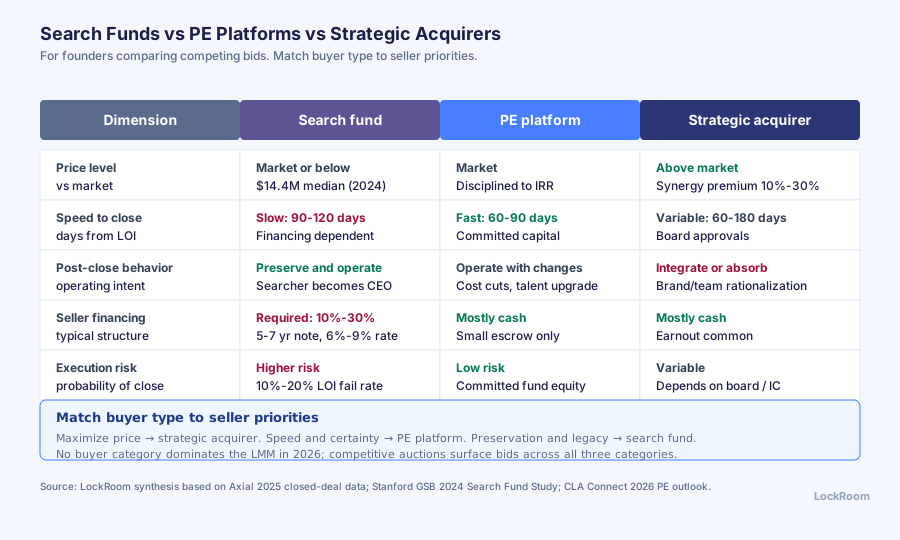
For a founder receiving competing bids from a search fund, a PE platform, and a strategic acquirer, the comparison runs across four dimensions:
Price. Strategic acquirers usually pay highest (synergy premiums). PE platforms next. Search funds typically pay market or slightly below. Median search fund purchase price was $14.4M in 2024, lower than PE platforms in the same EBITDA range.
Speed. PE platforms with committed capital are fastest (60 to 90 days from LOI). Strategic acquirers vary widely. Search funds are slower (90 to 120 days) due to financing logistics.
Post-close behavior. Strategic acquirers integrate. PE platforms operate-with-improvements. Search funds operate-with-preservation. The searcher becomes the new CEO; the business continues largely intact.
Seller financing requirement. Strategic and PE platforms pay mostly cash. Search funds require seller financing (10% to 30% of price typically).
Risk profile. Strategic acquirers and PE platforms have committed capital; close probability is high. Search funds have execution risk if equity is not committed; close probability depends on searcher quality.
Sector-specific search fund activity
Software / SaaS. Active. Search funds buy bootstrapped SaaS businesses where the founder built a profitable but small company. Lower acquisition multiples than VC-backed exits.
Industrial services. Very active. Service businesses with recurring revenue, route density, or specialized expertise are favored search fund targets.
Manufacturing. Active. Specialty manufacturing, niche components, B2B suppliers.
Healthcare services. Selective. Searchers who can navigate regulatory complexity (Stark, Anti-Kickback) target specific healthcare services niches.
Distribution and logistics. Active. Sticky customer relationships, repeatable operations.
Consumer. Less common. Consumer businesses are often family-owned and don't transition well to operator-CEO without brand continuity.
Professional services. Selective. Searchers who buy into accounting, legal, or consulting firms typically need to retain the rainmaker partners post-close.
Bottom line
Search funds have grown from a niche curiosity to 14% of all LMM closed deals in 2025. The model is real, the capital is real, the operator-CEO outcome is real. For founders who care about preservation over price, search funds are an excellent buyer category.
For founders considering a search fund offer:
- Compare the offer to PE platform and strategic acquirer bids; expect search funds to be slightly below market on price
- Plan for seller financing of 10% to 30% of price
- Verify the searcher's investor commitments before signing the LOI
- Expect 90 to 120 days to close
- Budget time for the founder-to-CEO transition (6 to 18 months)
For sell-side bankers fielding search fund bids:
- Pre-screen searchers at IOI for capital realism and track record
- Require binding equity commitments and senior debt term sheet evidence at LOI
- Tighten exclusivity to 60 to 90 days with backup-bidder optionality
- Set seller expectations on price (market, not strategic premium) and structure (seller financing required)
For search fund operators reading this:
- Show your work to the seller's banker. Investor commitments, debt term sheets, and operational track record build credibility.
- Recognize that you compete with all-cash buyers; differentiate on preservation, not price.
- Front-load the founder transition; the first 18 months determine the deal's IRR.
LockRoom data rooms are well-suited for search fund processes because they support the deep operational diligence searchers run. Permission tiers let you give the searcher's team progressive access during diligence, and audit logs document the diligence trail for the searcher's investors. If you are running a process that includes search fund bidders, [start a free trial](/) or [book a demo](/).
Earnout Structuring Matrix
Search fund deals lean heavily on seller financing and earn-outs. The matrix maps common LMM earnout structures with payout ranges, milestones, and protective language. Free PDF.