

Disclosure Schedule Preparation for Sell-Side LMM M&A
Disclosure schedules are the most-disputed deal artifact in late-stage LMM diligence. 200+ items typical. Start drafting alongside the LOI, not after the purchase agreement.
- Disclosure schedules are the most-disputed deal artifact in late-stage LMM diligence, with 200+ items typical on a complex deal and each disputed item adding time to close.
- Two types of disclosures: exception disclosures (carve-outs from rep coverage) and listing disclosures (required enumerations under specific reps).
- Start drafting alongside the LOI, not after the purchase agreement is drafted. Seller's counsel building schedules under post-LOI time pressure is the #1 source of late-stage retrade leverage.
- Top causes of disclosure schedule failures: incomplete information, outdated lists, inadequate cross-referencing to representations, ambiguous disclaimer language.
- Delaware courts (Mayer Brown 2025 alert) repeatedly hold ambiguous disclosure schedule language against the seller. Specificity and cross-referencing matter.
- Bottom line: disclosure schedules are not paperwork. They are the operational interface between the seller's actual business and the buyer's reliance interest. Preparation quality directly impacts closing certainty and post-close indemnity exposure.
What is a disclosure schedule?
A disclosure schedule is a supplemental document attached to the M&A purchase agreement that supports the representations and warranties made by the seller (or buyer). It functions as both a carve-out (the seller represents X "except as listed in Schedule Y") and an enumeration (the seller represents and lists all items of category Z in Schedule Z).
The purchase agreement makes broad representations: "The Company has good title to all material property." The disclosure schedule narrows that representation by listing exceptions: "Except as listed in Schedule 4.5, the Company has good title..." Schedule 4.5 then lists the specific exceptions (e.g., property held under capital lease, property subject to lien, property in dispute).
The schedule is binding on the seller. Anything not listed is implicitly within the rep. If the seller misses listing an exception, the buyer can claim breach post-close.
What goes into a typical disclosure schedule?
A typical LMM purchase agreement has 30 to 60 representations. Each rep may have an associated disclosure schedule. A complex deal can have 200+ specific items across 30 schedules.
Two structural types of disclosures, per practitioner guidance:
Exception disclosures. Carve-outs from a rep. The rep states a general truth; the schedule lists exceptions. Example: "Except as listed in Schedule 4.7, no Material Contract has been amended, modified, or supplemented since [date]." Schedule 4.7 lists every material contract amendment since the date.
Listing disclosures. Enumeration required by a rep. The rep requires the seller to list every item of a category. Example: "Schedule 4.12 lists every customer contract representing more than $250,000 in trailing twelve-month revenue." Schedule 4.12 is the actual list.
Noncontravention disclosure. A common third type listing required consents (government, shareholder, customer, lender) and identifying negative business consequences triggered by the transaction (change-of-control acceleration, lease termination, supplier renegotiation rights). This schedule is heavily reviewed by buyer's counsel.
What categories of items appear most often?
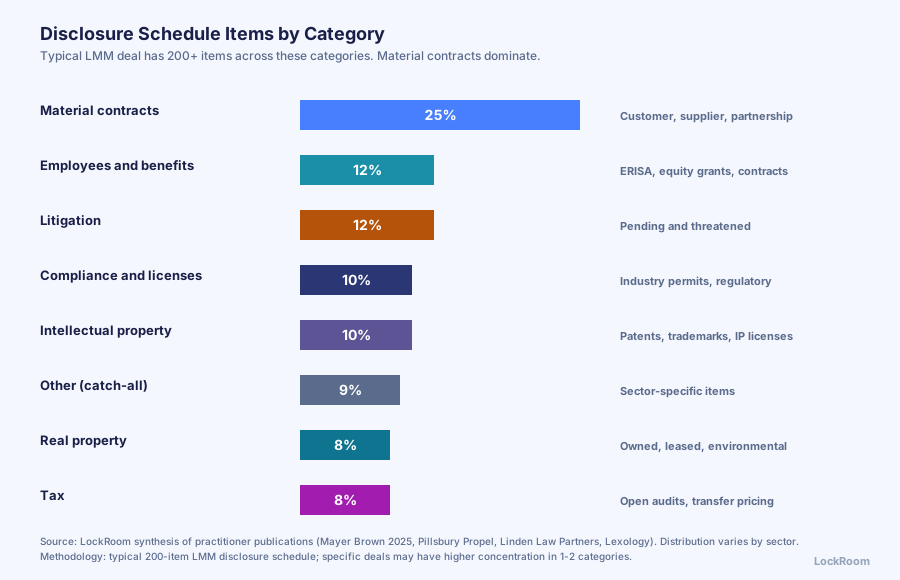
Across LMM deals, the disclosure schedule items concentrate in a handful of categories:
- Material contracts: customer agreements, supplier contracts, partnerships, JVs, distribution agreements
- Litigation: pending or threatened actions, settled actions still under appeal, regulatory inquiries
- Compliance and licenses: industry licenses, environmental permits, regulatory approvals
- Intellectual property: registered patents, trademarks, copyrights, IP licenses (in and out)
- Employees and benefits: senior executive contracts, change-in-control agreements, ERISA plans, equity grants outstanding
- Real property: owned real estate, leased premises with significant terms, environmental matters
- Insurance: all policies in force, claims history, gaps
- Tax: open audits, IRS or state tax matters, transfer pricing positions
- Customers and suppliers: top customer/supplier concentration, retention risks
- Compliance with laws: regulatory matters, OSHA, employment law, data privacy
When should disclosure schedule preparation start?
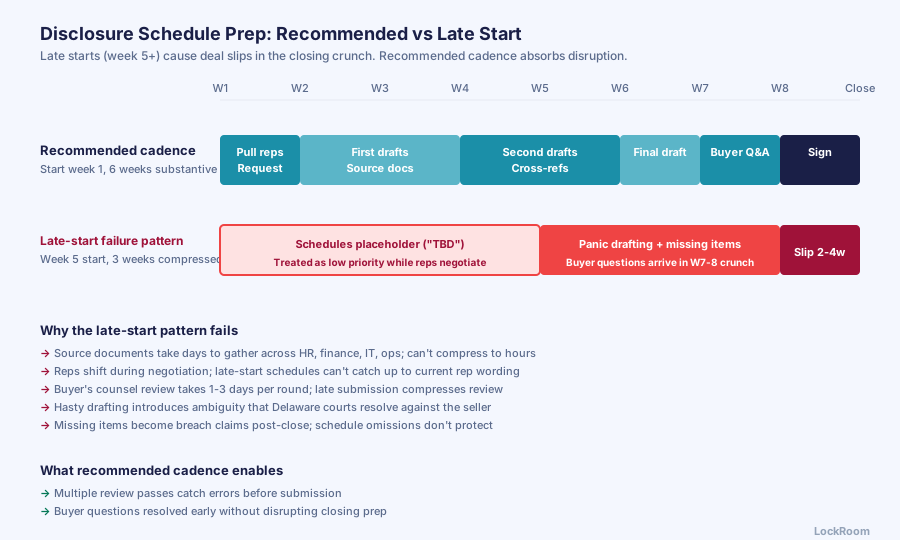
The dominant practitioner consensus from 2025 publications: start in week 1 of exclusivity, not week 7.
The case for starting early:
Information takes time to gather. Material contracts are often scattered across HR, sales, IT, and operations systems. Pulling a complete list with current status requires people from multiple departments who do not normally do M&A work.
Memory is unreliable. "Are there any pending lawsuits?" is a question an in-house lawyer answers with confidence in week 1. By week 7 of exclusivity, with three open issues bubbling, the answer is less crisp.
The rep often shifts during drafting. As the purchase agreement is negotiated, reps get tightened or loosened. The disclosure schedule has to track those shifts. Late-start schedules struggle to catch up.
Buyer's counsel reviews everything. Submitted schedules trigger questions. Each question takes 1 to 3 days of seller-side work. Late submission compresses that review window into the closing crunch.
Deals slip when schedules are incomplete. Per practitioner reports, hastily prepared disclosure schedules are the #1 reason deals slip in week 7 of exclusivity.
The right cadence:
- Week 1: seller's counsel pulls the rep list from the buyer's draft purchase agreement and begins requesting source documents
- Week 2-3: source documents collected; first draft of each schedule complete
- Week 4-5: second draft circulated; cross-references verified; ambiguities resolved
- Week 6: final draft to buyer's counsel for review
- Week 7: buyer questions answered; final updates
- Week 8: final, signed at closing
What common mistakes cost deals?
Per Mayer Brown's January 2025 Delaware Law Alert and other 2025 practitioner publications, the most common mistakes:
Ambiguous cross-references. "Except as set forth in the Disclosure Schedules" without specifying which schedule. Delaware courts have held this against sellers.
Inconsistent terminology. Different schedules using different terms for the same items (e.g., "Material Contract" vs "Significant Contract") creates ambiguity. Buyers exploit this.
Outdated information. A list compiled three months ago may be outdated by close. Pre-close updates are typical and required.
Missing items. The most expensive mistake. Items not listed are implicitly within the rep, so omission can become breach.
Incomplete supporting information. Listing a contract by name without the date, parties, or material terms. Buyers can challenge the disclosure as insufficient.
Disclaimer drafting that conflicts with the purchase agreement. Schedules often include limiting language ("This list is provided for reference only and does not constitute..."). When that language conflicts with the purchase agreement's reliance, courts apply the agreement's terms, not the schedule's disclaimers.
Hastily prepared schedules. The #1 deal-slip cause per practitioner reports. Hasty preparation leads to incomplete information, missing items, and ambiguous language.
Reps that drift during negotiation. A rep that gets tightened in the redline rounds requires the schedule to catch up. If the rep changes after the schedule is delivered, the schedule must be updated.
How does Delaware law treat ambiguous disclosure schedules?
Per Mayer Brown's January 2025 Delaware Law Alert, recent Delaware case law has consistently held ambiguous disclosure schedule language against the seller. The principle: the seller has an opportunity to be specific in the schedule. If the seller is ambiguous and the buyer relied on a particular interpretation, the buyer's interpretation typically prevails.
Practical implications for sellers:
- Be specific. "Schedule 4.7" instead of "the disclosure schedules"
- List individual items. Each material contract listed by name, date, parties, term
- Avoid catch-all language. "Except as may otherwise be provided" creates ambiguity
- Cross-reference precisely. If a rep references "Material Contracts," the schedule for Material Contracts should be precisely identified
- Don't rely on fine print. Disclaimers in the schedule that contradict the purchase agreement's reliance language will not protect the seller
How should sell-side counsel structure the disclosure schedule package?
Standard structure for a complete disclosure schedule package:
1. Cover page. Title, parties, effective date, signature block
2. General disclosure section. Standard disclaimers and qualifications applied to all schedules
3. Schedule-by-schedule. One schedule per representation, numbered to match the rep (Schedule 4.1 for Rep 4.1, etc.)
4. Cross-references. "See also Schedule X" notes where one item appears in multiple schedules
5. Updates and supplements. Pre-close updates documented in supplementary schedules with effective date
6. Signature page. Seller's authorized signatory acknowledgment
The numbering convention matters. Most LMM purchase agreements organize representations into Sections 4 (Seller's Reps) with sub-sections (4.1 Organization, 4.2 Authority, etc.). Schedules should mirror that exact numbering: Schedule 4.1, Schedule 4.2, etc. Misaligned numbering creates cross-reference ambiguity.
What should a sell-side banker do during disclosure schedule preparation?
The banker's role is operational coordination, not legal drafting. Concrete responsibilities:
Establish the data room as the source of truth. Disclosure schedules are usually built FROM the data room. If the data room is well-organized (per Sell side data room folder structure), schedule preparation is faster.
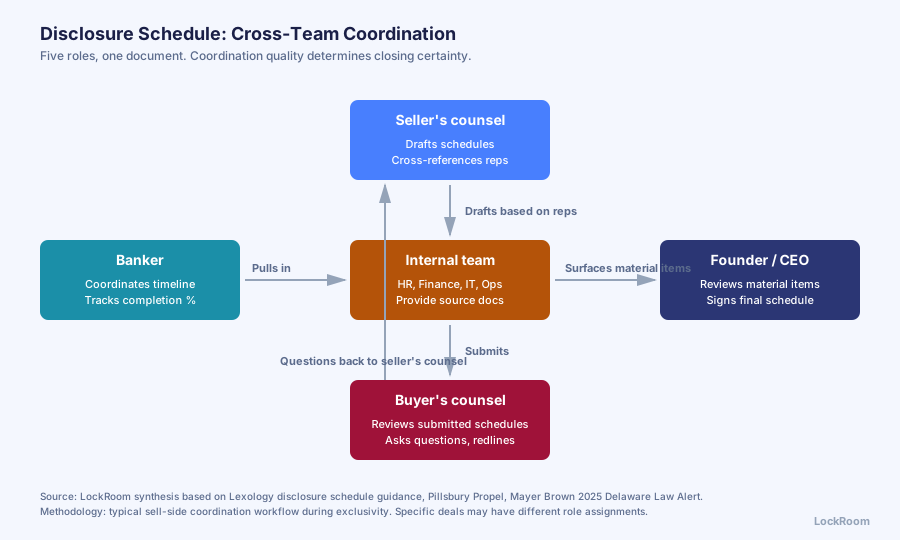
Coordinate the seller's internal team. HR, sales, IT, operations, finance each provide source documents. The banker's job is making sure the right people are pulled in and deadlines respected.
Track schedule completion percentage weekly. "Schedule 4.7 (Material Contracts): 80% complete, missing 3 customer contracts" is the right level of detail. Don't rely on counsel's "in progress" status updates.
Manage the buyer-side review timeline. Once schedules are submitted, the buyer's counsel reviews and asks questions. The banker's job is keeping the seller responsive within agreed turnaround times.
Identify retrade risk. Items in the schedule that are likely to spawn retrade conversations (significant litigation, customer concentration, environmental matters) should be flagged early so the seller can decide on remediation or pricing.
Sector-specific notes
Healthcare: regulatory disclosures (Stark, Anti-Kickback), billing audits, payer contracts. Schedule complexity is highest in healthcare.
Software / SaaS: IP ownership, open source compliance, customer contracts with auto-renewal terms. Customer concentration disclosures matter.
Manufacturing: environmental disclosures, product liability, customer agreements with volume commitments.
Professional services: employment agreements, partner equity arrangements, customer concentration tied to specific partners.
Financial services: regulatory disclosures, license enumerations, compliance program documentation.
Bottom line
Disclosure schedules are the operational interface between the seller's actual business and the buyer's reliance. Preparation quality determines closing certainty, indemnity exposure, and R&W coverage scope.
For sell-side bankers running LMM processes:
- Start schedule preparation in week 1 of exclusivity, not week 7
- Track schedule completion percentage weekly with seller's counsel
- Coordinate the seller's internal team (HR, finance, IT, ops) so source documents flow to counsel on time
- Identify retrade-risk items in the schedule early; remediate or price-adjust before they become buyer leverage
For seller's counsel drafting schedules:
- Mirror the purchase agreement's rep numbering
- Be specific in cross-references; avoid ambiguous catch-all language
- Update schedules whenever reps change in negotiation rounds
- Don't rely on disclaimer language to protect the seller; rely on specific listing
For founders / seller principals:
- Provide source documents on request, not later
- Recognize that the schedule is binding; don't omit items because they're awkward
- Read the final schedule before signing; question anything you don't understand
LockRoom data rooms support disclosure schedule preparation directly. The folder structure mirrors typical schedule categories so seller's counsel can pull source documents efficiently. Permission tiers let counsel access financial folders during prep without exposing them to bidders. If you are running a process and want a data room that streamlines schedule preparation, [start a free trial](/) or [book a demo](/).
Sell-Side Diligence Prep Checklist
The pre-launch diligence prep checklist used by sell-side bankers. Mirrors the disclosure schedule categories. Free PDF download.